
Thinking About Braces? You’re Not Alone
Let’s be real—no one wakes up thinking, “Today’s the day I’ll get dental braces in Manila.” But if you’ve ever avoided smiling in photos, kept your lips closed when you laugh, or felt tightness in your jaw, it might be time to look into it.
Why People Get Braces in the Philippines
At Smile More Dental Clinic in Ermita, Manila, we’ve seen it all—from teens dealing with crowded teeth to adults who want a cleaner, more confident smile. The truth? Getting braces in the Philippines isn’t just about how you look—it’s about protecting your long-term oral health.
Most Smiles Aren’t Born Perfect – And That’s Okay
Let’s face it: most of us didn’t win the genetic lottery for perfectly aligned teeth. Maybe your front teeth overlap. Maybe your bite feels a little off. Or maybe you’ve just noticed that you don’t smile like you used to. That’s where braces come in.
Braces Fix More Than Just Your Smile
Braces aren’t just for looks. They correct what you can’t always see—like crooked teeth, jaw misalignment, or chronic tension in your face and neck. Your mouth could be silently asking for help. At Smile More Dental Clinic, we’ve helped hundreds of patients bring their teeth—and their confidence—back in line.
“Orthodontic treatment is an investment in your health and well-being.” — AMERICAN ASSOCIATION OF ORTHODONTISTS.
When Is It Time to Consider Braces, And Why Consider Dental Braces?
Ever feel a bit self-conscious about your smile? You’re not alone. Braces aren’t just metal and wires—they’re a step toward better oral health and more confidence when you look in the mirror. Orthodontics is the branch of dentistry that handles issues like crooked teeth or jaw misalignment. With steady, gentle pressure, braces guide your teeth into better positions, improving how your smile works and how it looks.
We all have that one friend who “never needed braces.” But for most of us, here’s what often brings us to the dentist’s chair:
Identifying the Need for Braces
You might benefit from braces if you experience:
| Teeth & Jaw Condition/s | Description/s |
| Overbite | Upper front teeth extending beyond the lower teeth. |
| Underbite | Lower teeth protruding past the upper front teeth. |
| Deep Bite | Upper front teeth cover most of the lower front teeth. |
| Open Bite | Front teeth do not meet when the mouth is closed. |
| Crossbite | Misalignment causing upper teeth to bite inside the lower teeth. |
| Spacing Issues | Noticeable gaps between teeth. |
| Crowding | Insufficient space causing teeth to overlap. |
| Jaw Misalignment | Discomfort or difficulty in jaw movement. |
- Overbite – That classic “buck teeth” profile where upper teeth extend far over the lower ones.
- Underbite – The opposite. Your lower teeth come forward more than the upper ones.
- Open or deep bite – When your teeth don’t touch properly or close down too much.
- Crossbite or asymmetry – If your smile tilts to one side or your jaw looks off-balance.
- Crowded or spaced teeth – When there’s either too little room or too much.
Some of these affect more than looks. They can trigger jaw pain (TMJ), cause early tooth wear, and make speech less clear. Think of it like a car with misaligned wheels—everything may seem okay until wear and tear catch up.
Addressing these concerns early can prevent complications like tooth decay, gum disease, and speech difficulties.

Types of Braces: Which One Fits You?
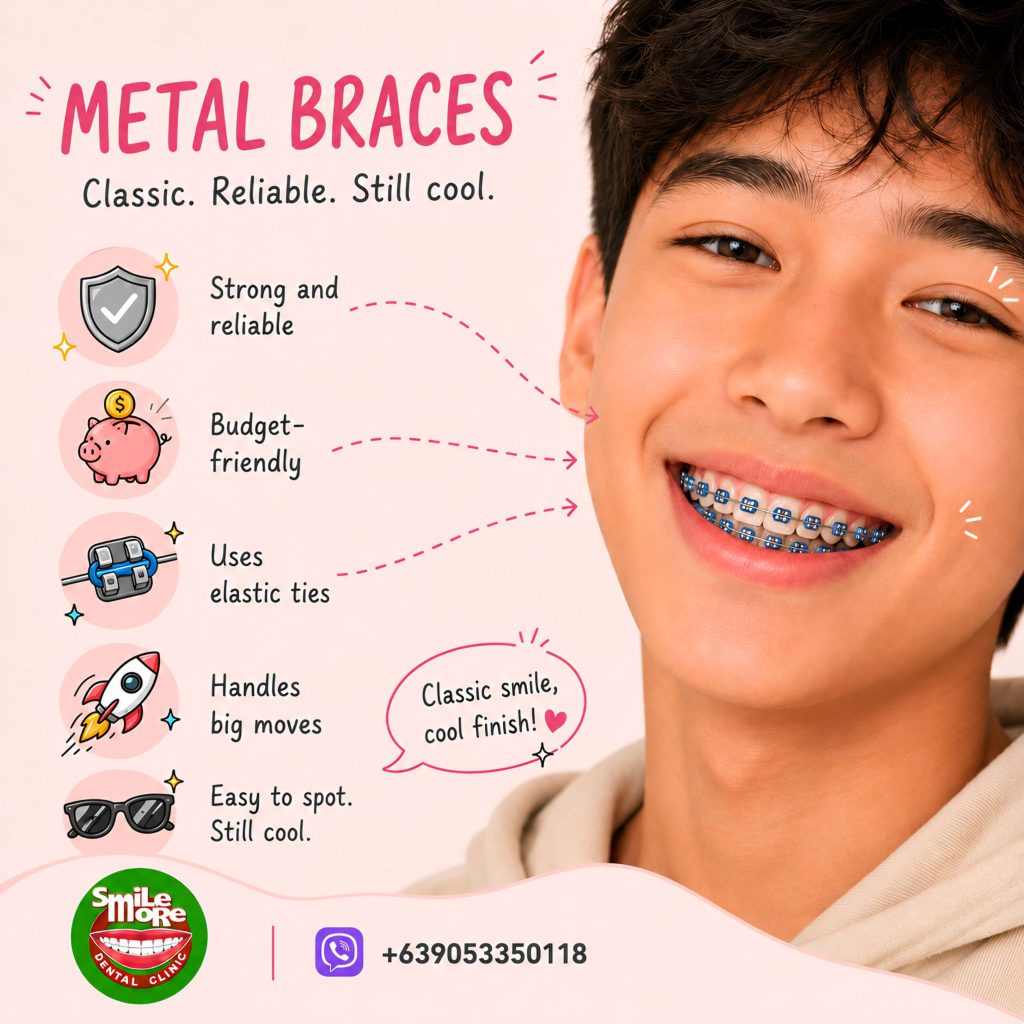
1. Metal Braces: Old School, Still Cool
Yes, they’re the classic “bracket-and-wire” combo you’ve seen for decades. But today’s metal braces are far sleeker than the ones that defined the ’90s “nerd look.”
And if braces cost in the Philippines is high on your list of concerns, metal braces usually give you the lowest starting price among the fixed-braces options we offer.
Why?
You’re paying for a proven way to move teeth without paying extra for tooth-colored brackets or a different bracket design.

They’re:
- Reliable. They can handle many types of tooth movement.
- Easy on the budget. Metal braces remain our most affordable fixed-braces option.
- Easy to spot. They’re not pretending to be invisible—and for many patients, that’s perfectly fine.
At Smile More, metal braces start at ₱60,000.
But here’s the part worth remembering:
The bracket may be standard. Your case isn’t.
Someone fixing a few crowded front teeth may need a very different treatment plan from someone correcting a more complex bite.
2. Ceramic Braces: For the Style-Conscious
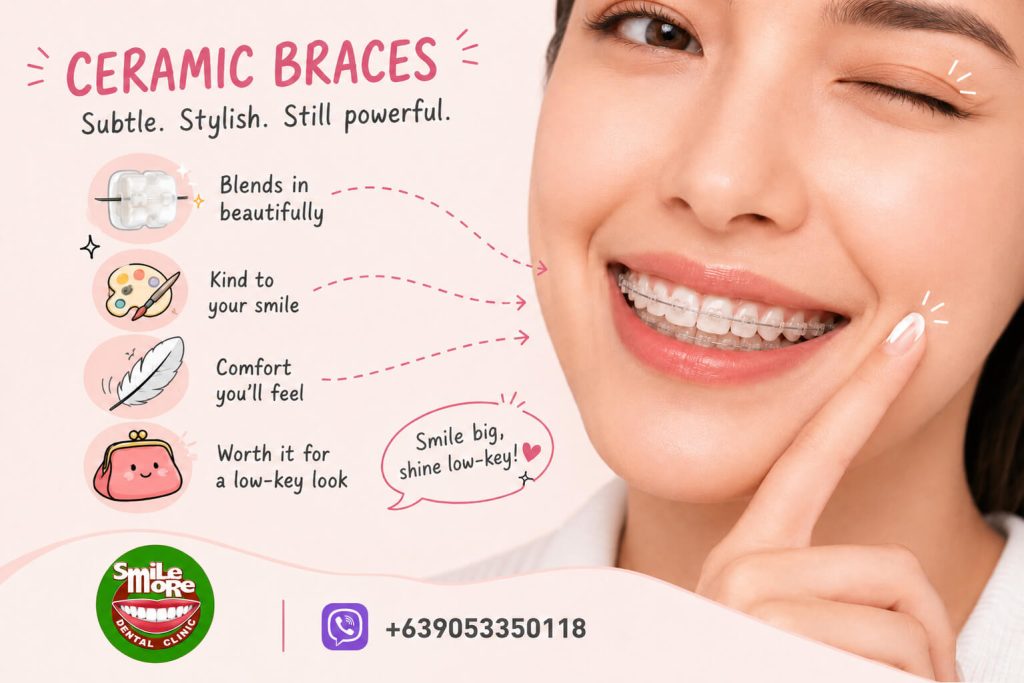
Want braces without making the braces the first thing people notice?
That’s where ceramic braces come in.
They work much like conventional fixed braces, but the brackets are designed to blend more closely with your teeth.
At Smile More, ceramic braces are a popular choice for a subtle look, even though they typically cost nearly twice as much as traditional metal braces.
So what are you paying more for?
Mostly, discretion.

You still get brackets.
You still get wires.
Your teeth still need regular adjustments.
The difference is what people see when you smile.
The trade-offs?
- They need a little more care.
- They can pick up stains around the ties.
- Ceramic brackets may be more delicate than metal ones.
- They cost more than conventional metal braces.
For someone who spends every day meeting clients, speaking to people, or simply wants their braces to attract less attention, that difference may be worth paying for. low-profile look is worth it.
How Long Will You Wear Metal Braces?
It depends on how far your teeth need to travel.
Many cases fall around the 18- to 24-month range, but orthodontic treatment does not run on a stopwatch.
A small alignment problem may take less time. A more complex bite may take longer. The American Association of Orthodontists likewise notes that treatment length varies with the amount and complexity of tooth movement needed.
And then there’s the part you control:
Show up.
Skip an adjustment and your teeth do not magically catch up at the next visit.
Braces work in steps. Miss enough steps and that finish line can start moving farther away.
3. Self-Ligating Braces: The “Speed Braces” People Ask About
You may have heard them called “speed braces.”
Catchy name.
But does that mean your braces automatically come off faster?
Not quite.
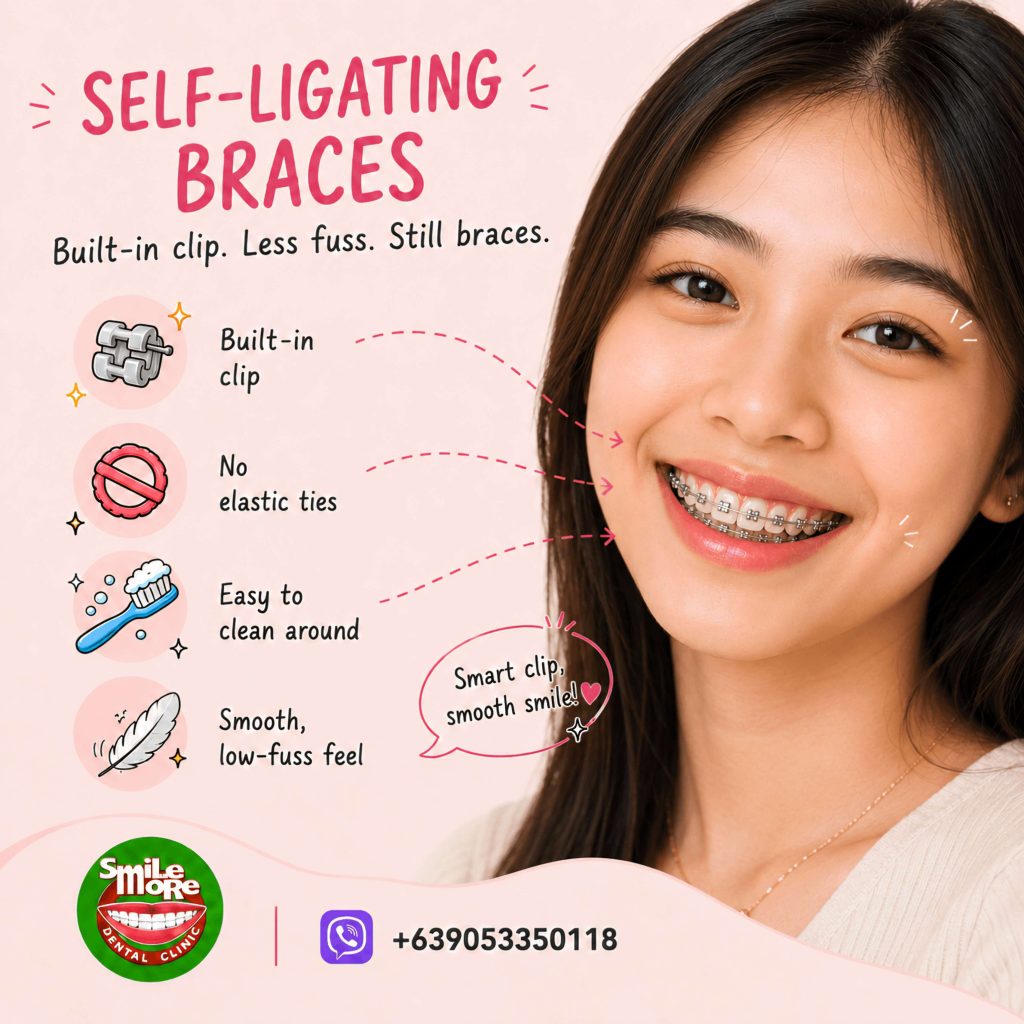
Self-ligating braces use a built-in clip to hold the wire instead of the elastic ties commonly used with conventional braces.
That changes the bracket system.

What it does not do is turn every 18-month case into a 12-month case.
Randomized clinical studies comparing self-ligating and conventional brackets have not consistently found shorter overall treatment times simply because self-ligating brackets were used.
At Smile More, self-ligating braces start at ₱95,000.
So why might someone still choose them?
They can make certain wire changes more straightforward.
No elastic ties around the brackets.
The bracket has its own opening-and-closing mechanism.
Some patients prefer the design.
But when it comes to the finish line, your bite still calls the shots.
How much movement do you need? How complex is the case? And are you keeping your appointments?
Those questions tell us far more than the bracket name alone.
Many patients choose these over metal braces because they value comfort and faster results.
“ADVANCEMENTS IN ORTHODONTIC TECHNOLOGY HAVE MADE TREATMENTS MORE COMFORTABLE AND EFFICIENT THAN EVER BEFORE.” — American Association of Orthodontists
4. Invisalign – The Invisible Option
Want straighter teeth without broadcasting the fact that you’re straightening them?
That’s the appeal.
Invisalign uses a planned series of clear, removable aligners rather than brackets and wires.
They’re discreet. You can remove them to eat. And there are no metal brackets across the front of your teeth.
Sounds easy?
Here’s the catch:
Removable only works if you remember to put them back.
Your aligners spend plenty of time out of sight—but they still need to spend enough time on your teeth to do their job.
And not every orthodontic problem is best treated with the same appliance.

- Invisalign works best for mild to moderate alignment issues.
- The trays are removable but only work if you wear them 22 hours a day.
- You’ll switch trays every 10–14 days, completing the process in about 12–18 months.
- Kids? Not ideal. Adults and responsible teens? Perfect match.

So rather than asking:
“Which one looks best?”
ask:
“Which one can predictably make the tooth movements my case needs?”
That question can save you from choosing an appliance based on appearance alone.
Not sure which teeth braces fit you best? Let’s match your budget with the right materials.
How Much Do Braces Cost in the Philippines?
Wondering how much braces cost in the Philippines?
You’re definitely not the only one.
In fact, the price is usually one of the first things patients want to know.
Fair enough.
Average Braces Cost in the Philippines:
Dental Braces cost between ₱ 45,000 to ₱ 200,000. Most packages include consultations and regular adjustments, but do not cover restorative dental services or retainers of choice.
But here’s where comparing prices gets tricky:
Two patients can choose the same braces and still need very different treatment.
So before deciding whether a quote is “cheap” or “expensive,” look at what the teeth actually need.
Why Can Two People Pay Different Prices for Braces?
Picture two patients.
The first has a few crowded front teeth.
The second has crowded teeth plus a bite problem, teeth that need more room, and movements that may take longer to complete.
Both choose metal braces.
Same brackets.
Not the same job.
That is why orthodontic cost can vary with treatment type, complexity, and duration—not simply with the appliance you choose.
A more involved case may require:
- more complex tooth movement;
- extra space to be created;
- additional appliances;
- extraction when clinically indicated;
- or a longer treatment period.
So when someone tells you:
“My braces only cost this much…”
remember that you may be comparing two completely different treatment plans.
What Affects the Cost of Braces?
The price tag on braces isn’t one-size-fits-all.
And this is where the number on the advertisement can get a little misleading.
Here’s what can really change what you pay.
Which Type of Braces Are You Choosing?
Metal, ceramic, self-ligating braces, and clear aligners do not start at the same price.
Part of the cost is the appliance.
The other part is what it takes to make that appliance work for your teeth and bite.
So when comparing a braces price in the Philippines, make sure you are comparing the same type of treatment—not just the number beside it.
Do You Need Dental Work Before Braces?
Sometimes the brackets have to wait.
You may first need:
- X-rays or orthodontic records;
- cleaning;
- fillings for cavities;
- gum treatment; or
- tooth extraction when the treatment plan calls for more space.
These may be separate from the braces fee.
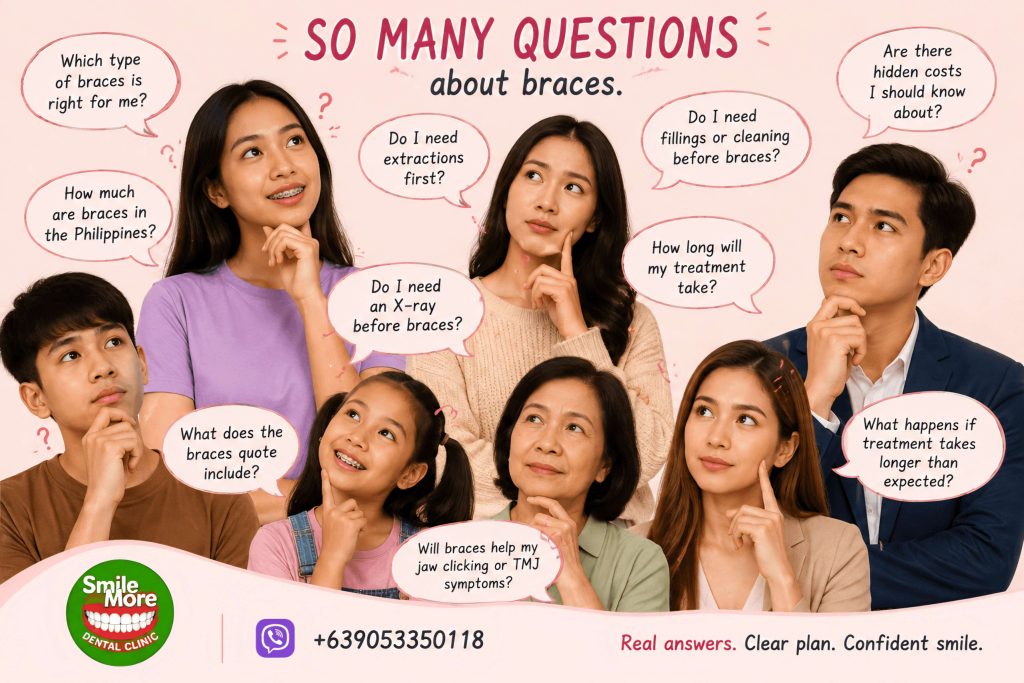
This is why patients often ask online:
“Do I need fillings before braces?”
“Do I need an X-ray before braces?”
“Extraction first—or braces first?”
The answer depends on your mouth and treatment plan.
- Your dentist’s experience – More experienced orthodontists may charge a bit more—and for good reason. You’re paying for expert eyes, precise adjustments, and peace of mind throughout the journey.
- Clinic Location – Where you get your treatment matters; clinics in high-demand spots like Ermita, Quezon City, Pasay, Makati, or Taguig may have different pricing depending on accessibility and foot traffic.
- Extra dental works before Braces – Some smiles need a bit of prep work. That could mean tooth extractions, orthognathic surgery, or other procedures before your braces start.
- How long the treatment takes– Complex cases take more time and visits. The longer the journey, the more adjustments can influence your total cost.
- TMJ issues or early jaw care -If your bite needs fixing or you’re dealing with TMJ symptoms, you might need special appliances or bite studies first. These early steps help set things right before the brackets go on.
Why Timelines Matter?
It’s easy to forget, but how often you show up shapes how fast your braces work. Whether your dentist says 18 months or 2 years, that timeline only holds up if you show up for every visit. Miss a few, and you’re not just pausing treatment—you’re slowing down your whole progress.
Skip an adjustment? Delay a visit?
You’re not just pushing the finish line—you’re adding detours. Each missed step throws off the rhythm, making the journey longer than it needs to be.
Insurance Coverage
Some dental insurance plans in the Philippines might help cover part of your braces—but not all do. Orthodontics is often an add-on, not a standard benefit. Best move? Double-check your coverage so there are no surprises when the bill arrives.
Payment Options at Smile More
We believe dental care should be accessible. That’s why we offer payment options that flex with your budget—so you can start treatment without the stress. Pay how that works for you—whether by cash, card, check, or flexible installment terms. We usually require a minimum down payment of 40% to 50% of the total agreed price for braces to begin treatment.
How to Choose the Best Braces for Your Budget, Lifestyle, and Timeline
Most patients pause here, so let’s break it down clearly. The cost of braces in Manila varies depending on several real-world factors.
Let’s simplify:
| Type | Best For | Cost Estimate | Aesthetic | Treatment Time |
| Metal Braces | All cases, especially teens | starts at ₱ 45,000 | Visible | 18 – 24 months * |
| Ceramic Braces | Style-conscious adults/teens | starts at ₱ 70,000 | Less Visible | 18 – 24 months * |
| Self-Ligating Braces | Busy adults who want faster results | starts at ₱ 90,000 | Slight noticeable | 12 – 18 months * |
| Invisalign | Professionals, public-facing roles | starts at ₱ 180,000 | Invisible | 12 – 18 months * |
* Note: Treatment timeframes are only estimates. Your actual duration will depend on case complexity and how often you attend your adjustment visits.
Each type has its strengths. Your dentist’s job is to help you pick what’s best for your needs and lifestyle. Our job? To make sure you feel good every step of the way.
Transferring Braces to a New Dentist? Read This First:
We often meet patients with braces already in place, asking if we can simply “take over” their treatment. Maybe they recently moved to Manila. Maybe they feel uncertain about continuing with their previous dentist. Or perhaps they’ve missed a few visits and want a fresh start.
Why Patients Consider Switching
Life changes—relocations, schedule conflicts, or a shift in trust—can all prompt patients to seek a new provider mid-treatment. Understandably, they want continuity and results. But orthodontics isn’t like switching salons. It’s a treatment built on precision, planning, and trust.
Incomplete Records Create Risks
We weren’t there when your original dentist adjusted your bite or placed your wires. Without that context, continuing treatment becomes uncertain. Even a minor oversight can delay your results or lead to bite problems later on. It’s not worth the risk to your smile.
Why Most Clinics Decline Mid-Treatment Transfers
Many clinics—including ours—prefer not to accept transfer cases for ongoing braces treatment. It’s not a lack of willingness to help. Rather, it’s a commitment to patient safety, outcome integrity, and responsible care.
Each Orthodontist Has a Unique Approach
Orthodontists plan treatments differently. What one dentist maps out, another may interpret in an entirely different way. No two cases—or providers—are ever identical. That’s why we don’t “pick up where someone else left off.” Instead, we perform a full evaluation. We check the bite, bracket positioning, wire tension, and how your teeth have responded so far. Only then can we offer an informed plan based on clinical judgment—not assumptions.
Dental Braces Transfer Cost in Manila: What to Expect
If you’re considering switching, it’s essential to understand that restarting treatment may increase the total cost of dental braces in Manila. Proper reassessment often involves new diagnostic records, possible appliance replacements, and adjustments to your timeline.
What’s the Best Path Forward?
If you’re thinking of transferring, start by reaching out to your current orthodontist. In many cases, staying the course may be the most practical and cost-effective choice. If that’s no longer an option, we’re happy to discuss what’s possible after a complete case evaluation.
Why You Need a Clear Agreement
For everyone’s peace of mind, we always recommend starting with a written treatment agreement. It lays out what to expect—who’s responsible for what, what happens if appointments are missed, and how timelines might shift if changes come up. It protects you and helps us give you the care you signed up for.
Braces Work Best When We Work Together
Getting braces isn’t a one-time thing—it’s a team effort. Those small brackets and wires only work if they’re checked and adjusted regularly. When visits are skipped, the plan goes off track. That’s why staying consistent matters—and so does the trust between you and your dentist.
So before switching mid-treatment, pause and ask:
Are you giving your current orthodontist the chance to see the plan through?
Behind every adjustment is precision, planning, and care built over time.