

A painful, broken, or infected tooth does not always need to come out.
Whenever possible, your dentist should first check whether treatment can still save it. A filling, root canal, crown, or gum treatment may extend the tooth’s useful life.
However, some teeth become too damaged, loose, infected, or difficult to restore.
If a tooth has a poor prognosis, your dentist does not expect it to stay healthy or useful for long. Keeping it may lead to more pain, swelling, infection, or damage to the nearby gums, bone, or teeth.
In these cases, tooth extraction may offer the better long-term option.
If you are considering tooth extraction in Manila, we first examine the tooth and understand the problem before planning removal.
Does the Tooth Really Need to Come Out?
Before extraction, ask one important question:
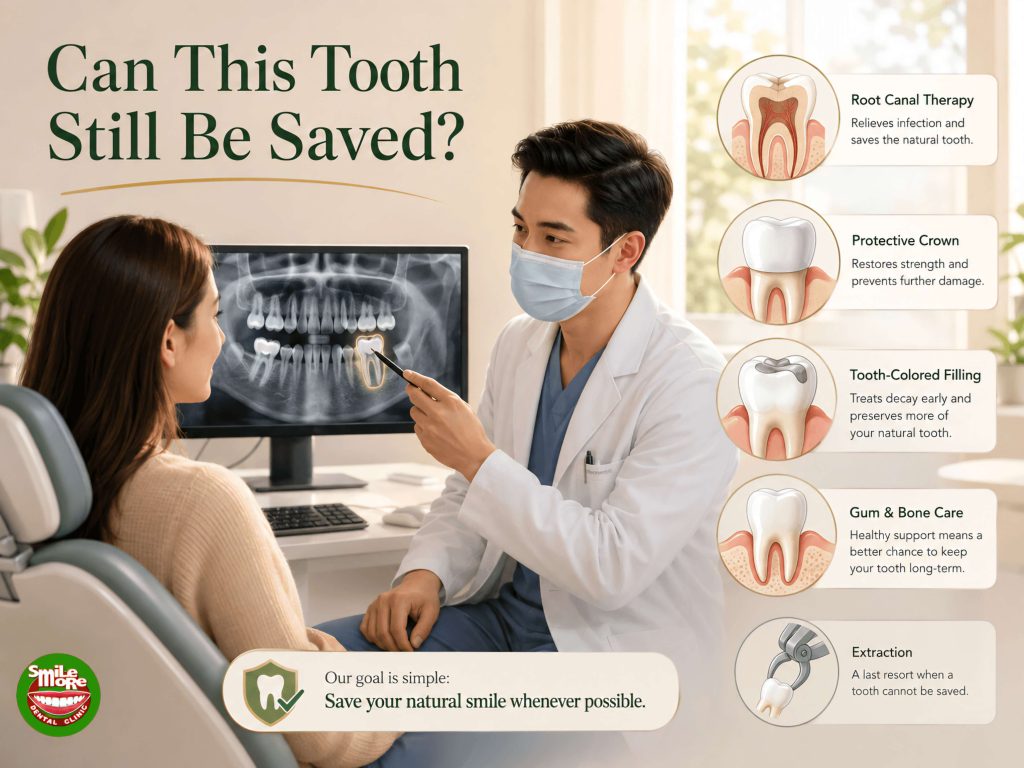
Can this tooth still be saved?
Sometimes, the answer is yes.
For example:
- a root canal may treat infection inside a tooth;
- a crown may protect a badly weakened tooth;
- a filling may repair smaller areas of decay; or
- gum treatment may help when enough bone still supports the tooth.
However, saving a tooth only makes sense when it has a reasonable chance of staying healthy and useful.
If repeated repairs cannot resolve the problem, removing the tooth may prevent a future painful episode.
When Might You Need a Tooth Extraction?
A dentist may consider tooth removal when:
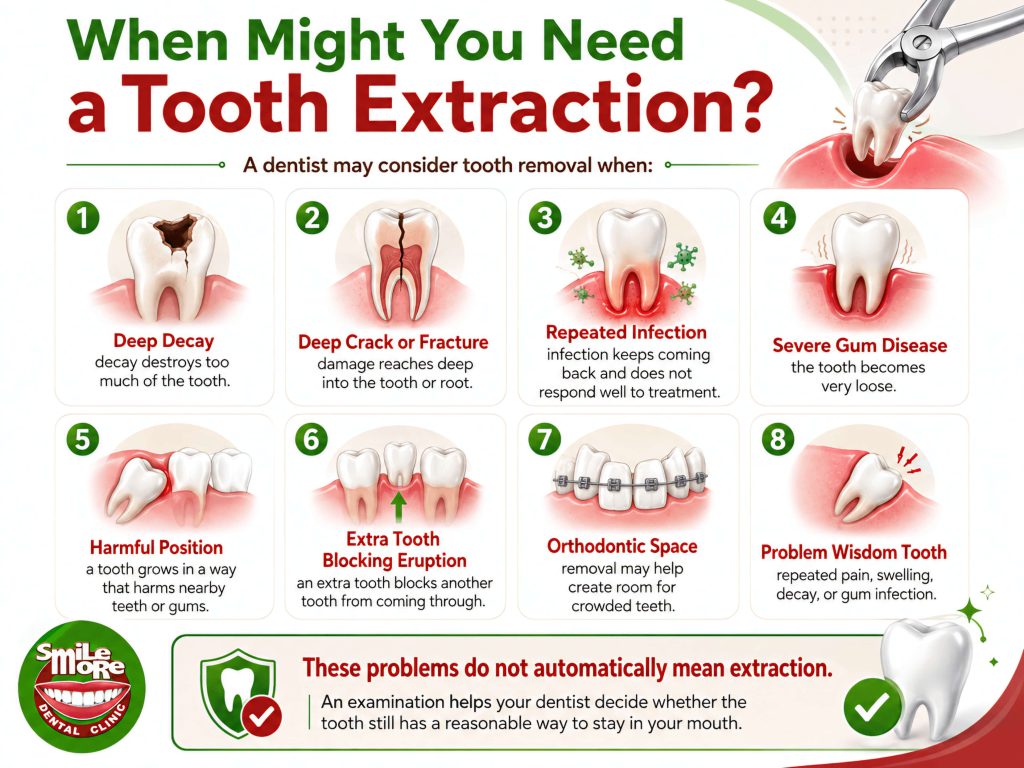
- deep decay destroys too much of the tooth;
- a crack or fracture reaches deep into the tooth or root;
- infection keeps returning, and the tooth cannot respond well to treatment;
- severe gum disease leaves the tooth very loose;
- a tooth grows in a position that harms nearby teeth or gums;
- an extra tooth blocks another tooth from coming through;
- an orthodontic plan needs more room to move crowded teeth; or
- a wisdom tooth can cause repeated pain, swelling, decay, or a gum infection.
These problems do not automatically mean extraction.
An examination helps your dentist decide whether the tooth still has a reasonable way to stay in your mouth.
Simple or Surgical Tooth Extraction?
Not every tooth extraction uses the same method.
For tooth extraction in Manila, the right approach depends on the tooth, its roots, and the bone around it.
A tooth may look easy to remove above the gum. However, an X-ray may show curved roots, bone over the tooth, or a root that sits deep below the gum.
These details help your dentist decide between a simple extraction and a surgical extraction.
| What to Compare | Simple Extraction | Surgical Extraction |
|---|---|---|
| Usually used for | A tooth the dentist can see and reach above the gum | A tooth or root that sits partly or fully below the gum or bone |
| Common example | A loose tooth or a tooth that has fully come through the gum | An impacted tooth, a badly broken tooth, or a root left under the gum |
| What the dentist does | Loosens the tooth and removes it | May open the gum, remove a small amount of bone, or divide the tooth into smaller pieces |
| Stitches | Often not needed | May be needed to hold the gum in place while it heals |
An impacted tooth is a tooth that cannot fully come through the gum. Part or all of it may remain trapped under the gum or bone.
A surgical extraction does not mean that something went wrong. In some cases, the tooth’s position, roots, or surrounding bone makes surgery the safer way to remove it.
If you are planning a tooth extraction in Manila, it helps to know what happens during the procedure.
Read our Tooth Extraction Procedure Guide: Simple vs Surgical Extraction.
Need Tooth Extraction in Manila?
You cannot always tell by looking at the tooth.
An examination and the right X-ray can help us see what sits below the gum before we plan treatment.
Book a Tooth Extraction Assessment
Thank you for your patience. Our schedule often fills early, so booking ahead helps.
What Happens BEFORE Tooth Extraction?
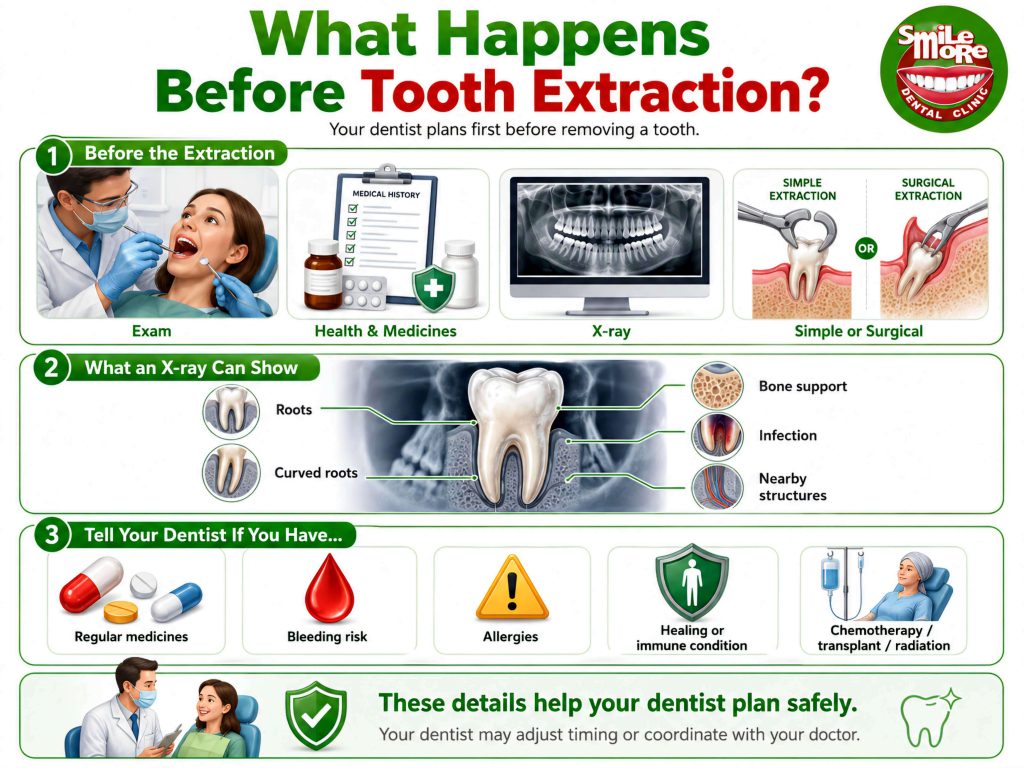
Before removing a tooth, your dentist may:
- Examine the tooth and gums.
- Ask about your medical history and medicines.
- Check an X-ray when needed.
- Decide whether a simple or surgical approach suits the tooth.
An X-ray can reveal details that your dentist cannot see inside the mouth, such as:
- how many roots the tooth has;
- whether the roots curve or spread apart;
- how much bone surrounds the tooth;
- whether infection sits around the root; and
- how close the tooth lies to nearby structures.
These details help the dentist plan the extraction before treatment starts.
Tell Your Dentist About Your Health and Medicines
Your health can affect dental treatment.
Tell your dentist if you:
- take regular medicines;
- use medicines that affect bleeding;
- have allergies;
- have a medical condition that affects healing or immunity; or
- plan to undergo chemotherapy, organ transplantation, or head and neck radiation.
These conditions do not automatically mean you need an extraction. However, your dentist may need to adjust the timing of treatment or coordinate with your doctor..
What Happens DURING a Tooth Extraction?
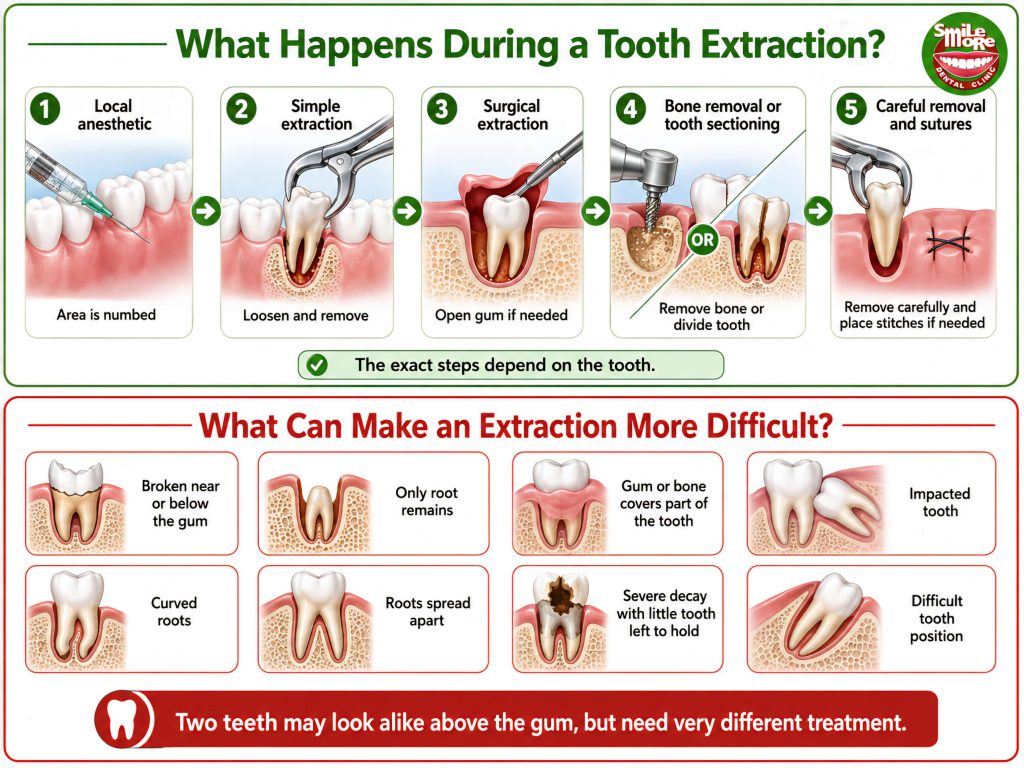
First, the dentist uses a local anesthetic to numb the treatment area while you stay awake.
For a simple extraction, the dentist gently loosens the tooth and removes it from its socket—the space in the jawbone where the tooth sits.
A surgical extraction may require extra steps.
For example, the dentist may:
- make a small opening in the gum;
- expose part of the tooth or root;
- remove a small amount of bone when necessary;
- divide the tooth into smaller sections;
- remove each section carefully; or
- place sutures, the dental term for stitches, when needed.
The exact steps depend on the tooth.
See what happens step by step in our Tooth Extraction Procedure Guide.
What Can Make an Extraction More Difficult?
A tooth may need more planning when:
- it breaks close to or below the gum;
- only a root remains;
- gum or bone covers part of the tooth;
- the tooth remains impacted;
- the roots curve sharply;
- the roots spread far apart;
- decay leaves little tooth for the dentist to hold; or
- the tooth sits in a difficult position.
Two teeth can look alike above the gum. But their roots and surrounding bone may make one harder to remove than the other.
A difficult extraction does not always mean something went wrong.
Sometimes, the tooth was difficult from the start. Its roots, position, or the bone around it may call for a surgical approach.
In that case, surgery is not a setback. It is simply the right way to remove that particular tooth.
What Happens After Tooth Extraction?
Once the tooth comes out, your body starts forming a blood clot inside the socket.
That clot protects the area while early healing begins.
During the first stage of recovery, you will usually need to:
- keep pressure on the gauze as instructed;
- protect the blood clot;
- eat soft foods;
- avoid disturbing the extraction site;
- keep your mouth clean without irritating the wound; and
- follow your dentist’s instructions for medicines and activity.
- Some bleeding, swelling, and tenderness can occur after treatment.
- However, good aftercare matters because disturbing the blood clot can slow healing.
Read our Tooth Extraction Aftercare Guide for food, cleaning, swelling, bleeding, and healing instructions.
What About Wisdom Tooth Extraction?
Not every wisdom tooth needs removal.
However, a wisdom tooth may cause trouble when it:
- stays trapped under gum or bone;
- repeatedly causes pain or swelling;
- develops decay;
- traps food around the tooth beside it; or
- damages nearby teeth or gums.
An impacted wisdom tooth often needs different planning from a routine extraction.
For more details, read our guide to Wisdom Tooth Removal and Impacted Third Molar Surgery.
Before You Decide on Extraction
A painful tooth does not always need to come out.
But a tooth that can no longer stay healthy may cause more trouble if you keep treating only the symptoms.
The first step is simple:
Find out what is wrong, whether the tooth can still be saved, and what happens if you leave it untreated.
Then you can make the decision with a clearer picture of your options.
Book a Dental Consultation at Smile More Dental Clinic in Ermita, Manila
What Happens to the Gap After a Tooth Comes Out?
Removing the tooth solves the immediate problem, but it may leave an empty space.
You do not need to replace every missing tooth. However, depending on the location, the gap may affect:
- chewing;
- your smile;
- your bite; or
- the position of nearby teeth.
Your dentist can explain whether it makes sense to:
- leave the space;
- replace the tooth with a dental implant;
- use a dental bridge; or
- consider a partial denture.
The right choice depends on your mouth, the missing tooth, nearby teeth, bone, and long-term needs.
When Should You Have a Tooth Checked?
Arrange a dental examination if you have:
- tooth pain that keeps returning;
- swelling around a tooth;
- a badly broken tooth;
- a tooth that moves when you chew;
- repeated infection around a wisdom tooth;
- pain when biting; or
- a tooth that has become difficult to clean.
Waiting too long can make some teeth harder to save.
However, knowing what causes the problem gives you more choices.
Frequently Asked Questions (FAQ’s) for Tooth Extraction
1. Does every painful tooth need extraction?
No. Pain can come from several problems, and some teeth can still respond to treatment. Your dentist needs to examine the tooth before deciding.
2. How do I know if I need a simple or surgical extraction?
The amount of visible tooth, root shape, position, surrounding bone, and other factors help determine the approach.
3. Does tooth extraction hurt?
The dentist uses local anesthetic to numb the area during treatment. You may feel pressure or movement, but tell the dentist if you feel pain.
4. Will I need an X-ray before extraction?
That depends on the tooth and the case. Imaging can help the dentist examine roots, bone, infection, and nearby structures before removal.
5. Do all extracted teeth need replacement?
No. The answer depends on which tooth comes out, your bite, chewing needs, appearance, and the condition of nearby teeth.
6. How long does a tooth extraction take to heal?
Healing happens in stages and varies with the type of extraction and the patient. → Read our Tooth Extraction Aftercare Guide.
Disclaimer: This page provides general information about tooth extraction and does not replace a dental examination, diagnosis, or treatment plan. Every tooth and patient is different. A dentist may need to examine your tooth and review an X-ray, your symptoms, and your medical history before recommending the right treatment.
Before You Decide on Extraction
Find out whether the tooth can still be saved or if extraction is the better option.
Our schedule often fills early, so booking ahead helps.