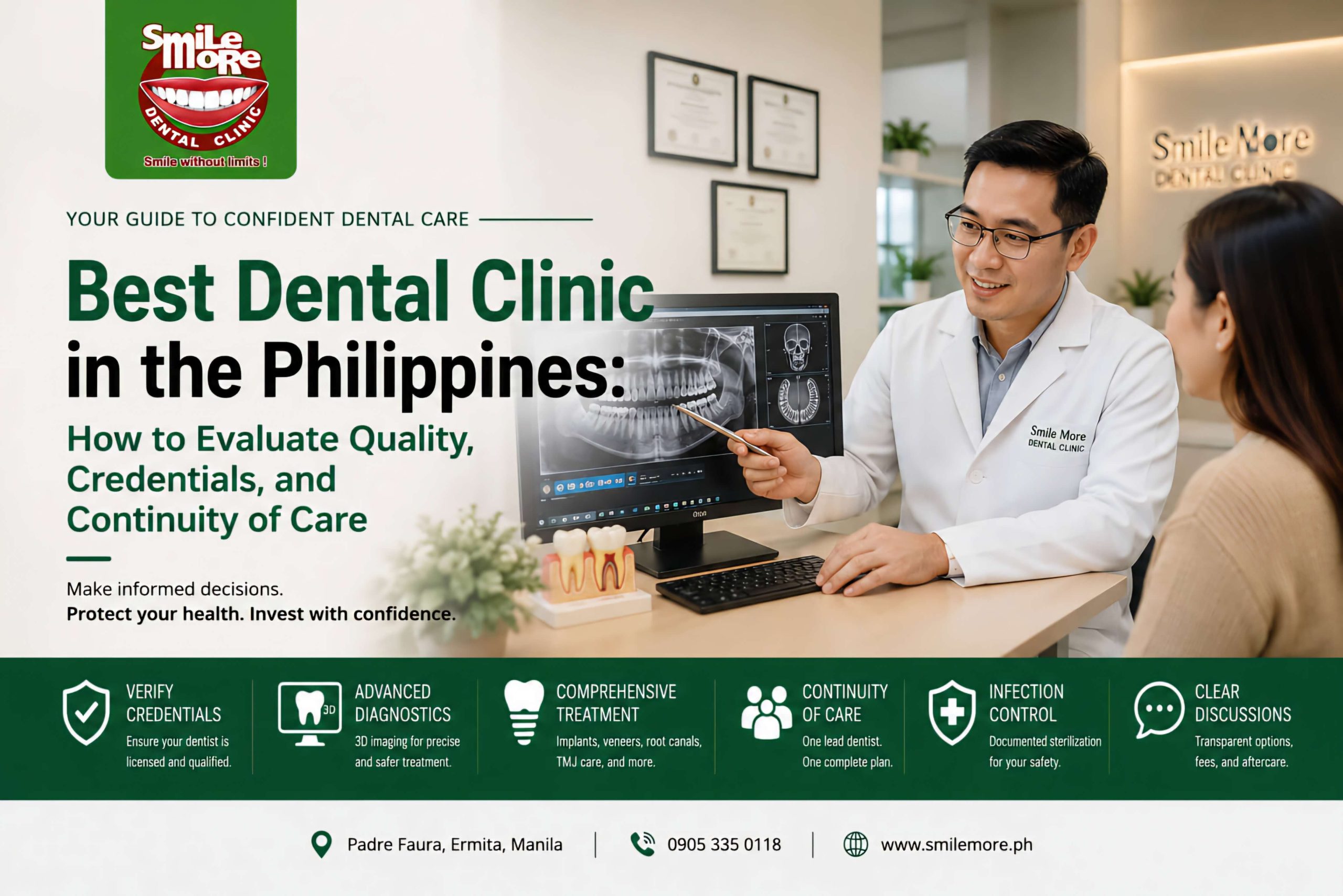
When you search for the best dental clinic in the Philippines, polished waiting rooms, five-star reviews, and low prices can catch your eye. But none of them tells you whether a clinic fits the treatment you need.
Look beyond ads, popularity, and price. Check how the dentist finds the problem, plans your care, controls infection, and follows you after treatment.
This guide will help you:
- verify the dentist’s credentials and relevant experience
- check how the dentist reaches a diagnosis and chooses imaging
- ask how the clinic prevents infection and sterilizes instruments
- find out who will coordinate your treatment
- understand what follow-up and maintenance may involve
Use these checks to compare clinics and find one that fits your treatment needs.
What Does “Best Dental Clinic” Really Mean?
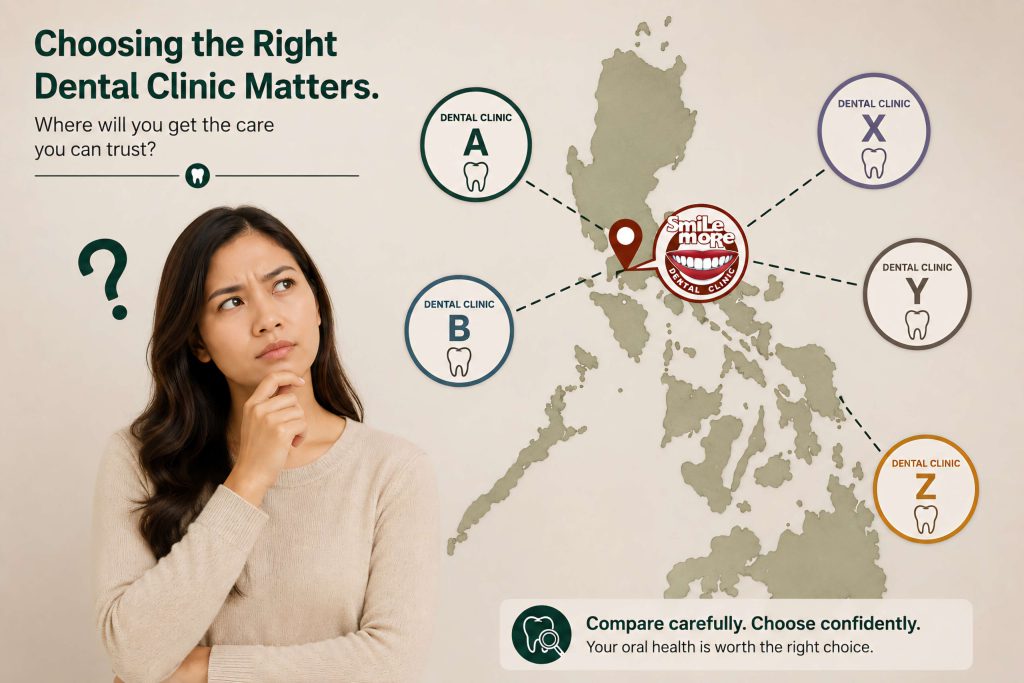
The best clinic is not always the one with the most reviews, the nearest branch, or the lowest price. What matters is whether it can handle the treatment you need.
A clinic may handle checkups, cleanings, and simple fillings very well. However, dental implants, complex fixed bridges, full-mouth rehabilitation, and other multi-stage treatments can require different skills, more planning, and closer follow-up.
Instead of:
“Which dental clinic is the best?”
Ask:
“Which dental clinic is the best fit for the treatment I need?”
Now you are comparing clinics by what your case requires, not simply by what looks popular or convenient.
How to Evaluate the Best Dental Clinic in the Philippines
Once you know what your treatment needs, use the same checks for every clinic you consider. That makes it easier to look past glossy photos, star ratings, and sales claims.
☐ Verify the dentist’s license — Can you confirm that the dentist who will treat you holds a current PRC license?¹
☐ Match the dentist’s experience to your case — Does the dentist regularly treat patients who need the same type of care?
☐ See the diagnosis for yourself — Can the dentist put your X-ray, photo, or scan on the screen, point to the problem, and explain what it means in plain language?
☐ Ask why you need the image — Does the X-ray or scan (Cone Beam Computed Tomography /CBCT) imaging ⁵ answer a question that matters to your diagnosis or treatment plan?
☐ Check how the clinic controls infection — Can the team explain how it cleans, sterilizes, stores, and checks reusable instruments?⁴
☐ Compare your treatment options — Does the dentist explain other suitable choices, along with their benefits, limits, costs, timelines, and care needs?³
☐ Know who will follow your case — Who will oversee your treatment, track your progress, and review you after the main procedure?
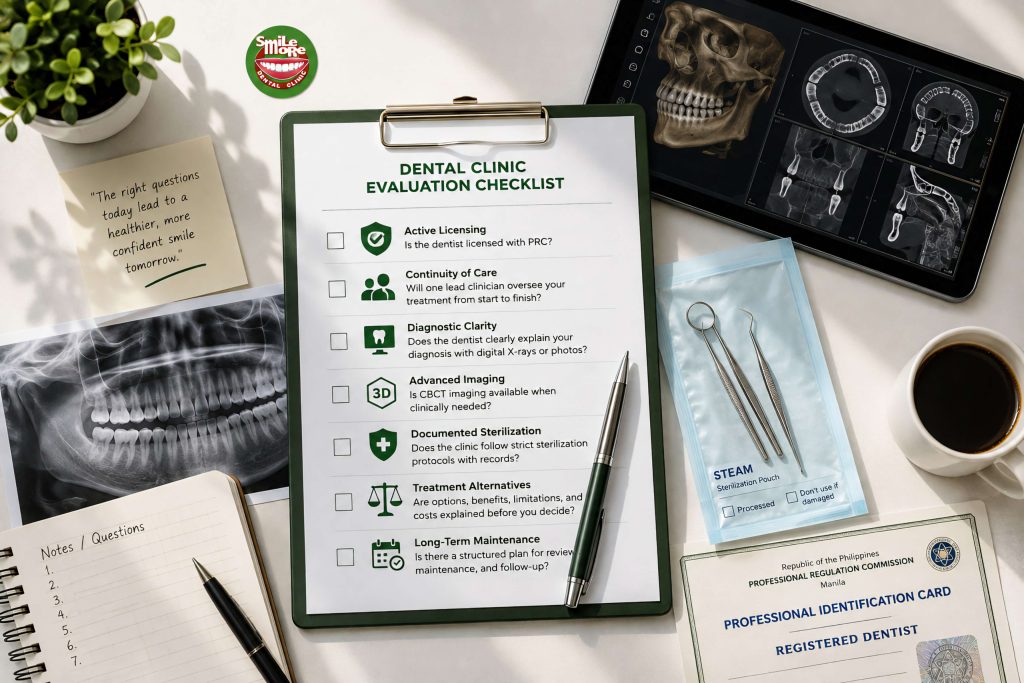
You do not need every answer during your first phone call. But before you commit to major treatment, you should know what the dentist found, why the treatment makes sense, what other choices you have, who will treat you, and who will follow your care afterward.
Quick Guide: Which Dental Clinic Model Fits Your Needs?
Dental clinics organize care in different ways. The right model depends on what you need treated, how complex the case is, and how much medical or long-term support you may need.
| If Your Situation Looks Like This | Practice Model to Consider | What This Setup Can Give You |
|---|---|---|
| You have facial trauma, a serious medical condition, or need treatment under general anesthesia. | Hospital dental department | The dental team can work alongside hospital doctors, surgeons, or anesthesiologists when your health needs more support. |
| You mainly need checkups, cleanings, simple fillings, or a clinic near home, work, or the mall. | Mall-based or multi-branch clinic | Convenience and geographic flexibility. |
| Your family needs general dental care plus access to several services within one network. | Regional dental group | Several locations can make routine visits and scheduling easier. |
| You need implants, complex bridges, veneers, full-mouth rehabilitation, or treatment that takes several stages | Centralized dental practice | One main location can keep your records, treatment plan, clinical team, and follow-up connected as your care moves from one stage to the next. |
Takeaway: No practice model is inherently better than another. The best choice depends on the treatment you need — not the clinic’s size, popularity, or location.
How Smile More Fits This Model
Smile More Dental Clinic in Manila works from one primary location. If your treatment takes several stages, the clinic keeps your records, treatment plan, and follow-up in one place. A lead clinician can also coordinate your care when another dentist or specialist needs to step in.
Check the Dentist: License, Experience, and How They Diagnose
Once the clinic model fits your needs, look at the dentist who will actually treat you. Can you verify the dentist’s license? Do they treat cases like yours, and can they show you why they recommend a treatment?
1. Verify the Dentist’s PRC License
Every dentist who practices in the Philippines must hold a current license from the Professional Regulation Commission (PRC) under the Philippine Dental Act of 2007 (Republic Act No. 9484).¹
A license tells you that the dentist can legally practice. It does not tell you how often that dentist performs the treatment you need.
Ask:
“Can I verify the PRC license of the dentist who will treat me?”
2. Ask About Experience With Your Treatment
Do not judge experience only by the number of years a dentist has worked.
Instead, connect experience to your case.
A dentist may treat routine fillings every day but handle dental implants, complex fixed bridges, root canal treatment, oral surgery, or full-mouth rehabilitation less often.
Ask:
“How often do you treat cases like mine?”
That question gives you more useful information than:
“How many years have you been a dentist?”
3. Check Whether the Diagnosis Uses the Right Imaging
You should not have to stare at an X-ray full of grey shapes and simply accept a treatment plan.
When possible, the dentist should put the X-ray, photo, or scan on a screen, point to the area of concern, and explain what they see in words you understand.⁵
| Imaging | Common Clinical Use |
| 2D dental X-rays | A standard dental X-ray can show enough detail for many common tooth and gum problems. |
| 3D CBCT | A CBCT scan can show a three-dimensional view of the jawbone, roots, impacted teeth, nerves, and nearby structures when the case calls for that detail. |
More imaging does not automatically mean better care.
Ask:
“What will this image show, and how will it change my treatment plan?”
The key is not whether the clinic owns the newest scanner. The key is whether the dentist can explain why your case needs that image and what they will learn from it.
Patient Safety: What Happens to the Instruments Between Patients?
A clinic can look spotless and still leave important questions unanswered. The real test happens after one patient leaves and before the next one sits in the chair.
The team should clean, sterilize, store, and handle reusable instruments in a clear, repeatable way. The clinic should also clean the surfaces and touch points used during treatment.⁴
Ask How the Clinic Checks Its Sterilization Process
Putting instruments in an autoclave is only one step.
The clinic should also check that the sterilization cycle works and keep records of those checks.
Ask:
“How do you check that your sterilization process is working?”
The team should be able to explain how it monitors the autoclave, uses biological or spore testing when required, and records the results.
Look Beyond a Clean-Looking Treatment Room
Infection prevention also includes cleaning treatment areas, disinfecting clinical surfaces, and replacing appropriate protective barriers between patients. These steps help reduce the risk of cross-contamination during dental care.⁴
The team should clean or disinfect these areas or replace protective barriers between patients.
Ask:
“What do you clean or replace between patients?”
A clean clinic should not just look clean. The team should be able to explain the steps it follows before you sit in the chair.
Understanding Dental Clinic Models in Metro Manila
When comparing the best dental clinic in the Philippines for your needs, the clinic’s setup can matter almost as much as its location. Different practice models suit different kinds of care.
These are not official regulatory categories. They are a simple way to compare how clinics organize treatment, records, and follow-up.
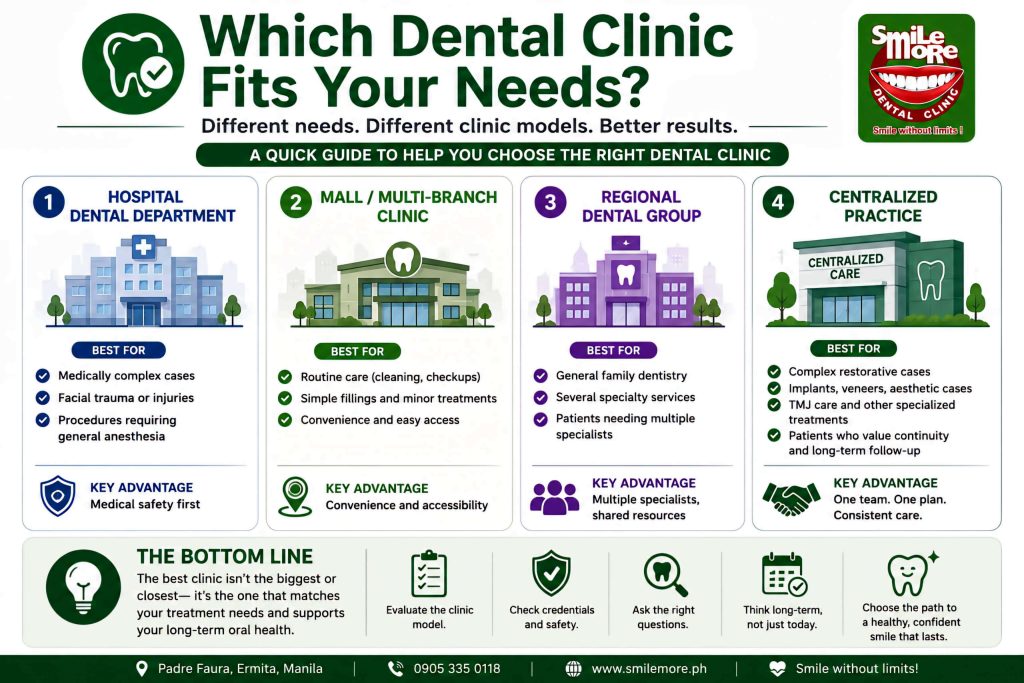
1. Hospital Dental Department
Best for: Complex medical conditions, facial trauma, or treatment that needs general anesthesia.
Why patients choose it: The dental team can work with hospital doctors, surgeons, or anesthesiologists when care goes beyond routine dentistry.
2. Multi-Branch Mall-Based Dental Clinic
Best for: Routine checkups, cleanings, fillings, whitening, and convenient appointments.
Why patients choose it: Multiple locations, flexible scheduling, and easier access for ongoing preventive care.
3. Regional Multi-Branch Dental Group
Best for: Families or patients who want several dental services within one network.
Why patients choose it: You can stay within the same group while seeing different dentists or services across several locations.
4. Centralized Dental Practice
A centralized dental practice works from one main location. Your X-rays, treatment notes, plans, and follow-up stay with the same clinical team as your care moves forward.
Best for: Dental implants, complex fixed bridges, porcelain veneers, full-mouth rehabilitation, or other care that takes several stages.
What this means for you: One lead dentist can keep track of the whole case while another dentist or specialist handles a specific stage when needed.
Takeaway: No clinic model works best for everyone. Match the setup to the treatment you need, the support your case may require, and how important it is for one team to follow your care over time.
Smile More Dental Clinic in Ermita, Manila follows a centralized practice model, with care coordinated from a single location.
Who Follows Your Care From Start to Finish?
Some dental treatment ends in one visit. Other treatment moves through several appointments, healing periods, adjustments, and follow-up checks. In those cases, who keeps track of the whole plan matters.
This is what continuity of care means: someone follows your case from the first diagnosis through treatment and later reviews.
That does not mean one dentist must do everything. A specialist may handle one stage while another dentist handles the next. What matters is that someone keeps the records, treatment plan, and progress connected.
With one clinician overseeing the case, the dental team can:
- compare how you look and feel now with earlier visits
- check how your gums, bite, or restorations change
- follow healing from one stage to the next
- spot problems during review visits
- adjust the plan when your case needs it
Ask:
“Who will follow my case from the first visit through treatment and follow-up?”
If several dentists or specialists will take part, also ask:
“Who keeps the whole treatment plan together?”
Convenience or Continuity: Which Matters More for Your Treatment?
For a checkup, cleaning, or simple filling, a clinic near home or work can make sense. Shorter travel and easier booking can help you keep regular visits.
But complex treatment can change what matters.
Dental implants, complex bridges, and other multi-stage care may involve several visits, healing time, and later checks. In these cases, ask who will follow your case from one visit to the next.
Practical takeaway: For routine care, location and schedule may come first. For complex treatment, look more closely at who treats you, who keeps track of your progress, and who follows you after each stage.
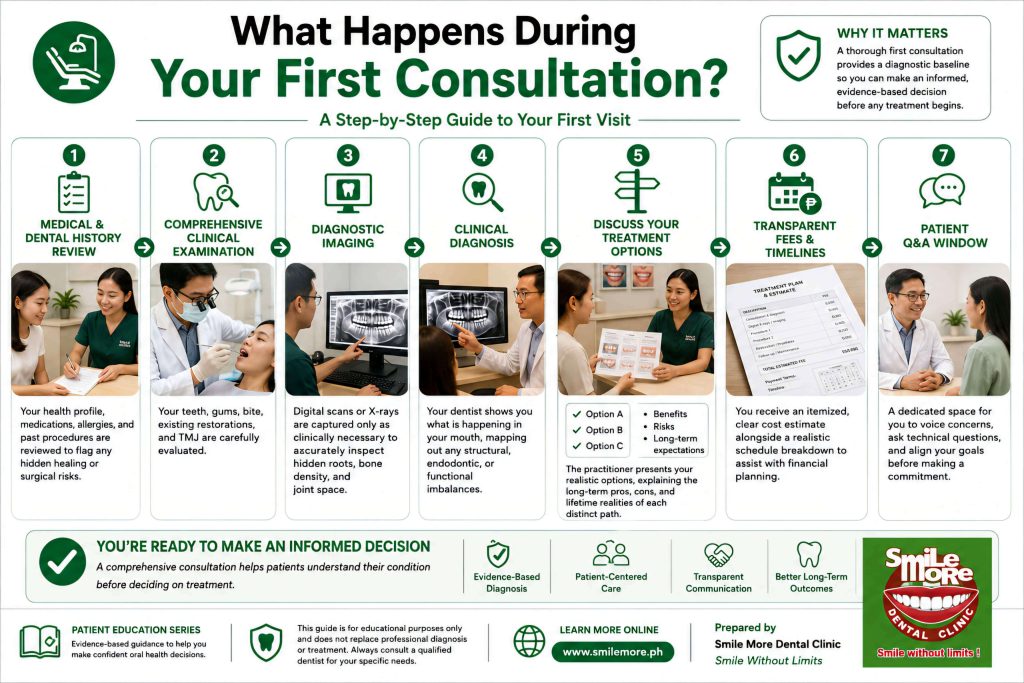
What to Look for During Your First Consultation
Your first consultation lets you see how the clinic works before you commit to treatment.
Pay attention to what happens in the room.
Does the dentist:
- ask about your health and the problem that brought you in?
- examine the areas that may affect your treatment?
- show you the X-ray, photo, or scan and point out what they found?
- explain why they recommend a treatment?
- discuss other suitable options when they exist?
- explain the likely cost, steps, and follow-up?
- give you time to ask questions?
You should leave with a clearer picture of what the dentist found, why the treatment may help, what choices you have, and what happens next.
If you leave with only a treatment name and a price, you may still need more information before you decide.
Before You Commit to Complex Dental Treatment
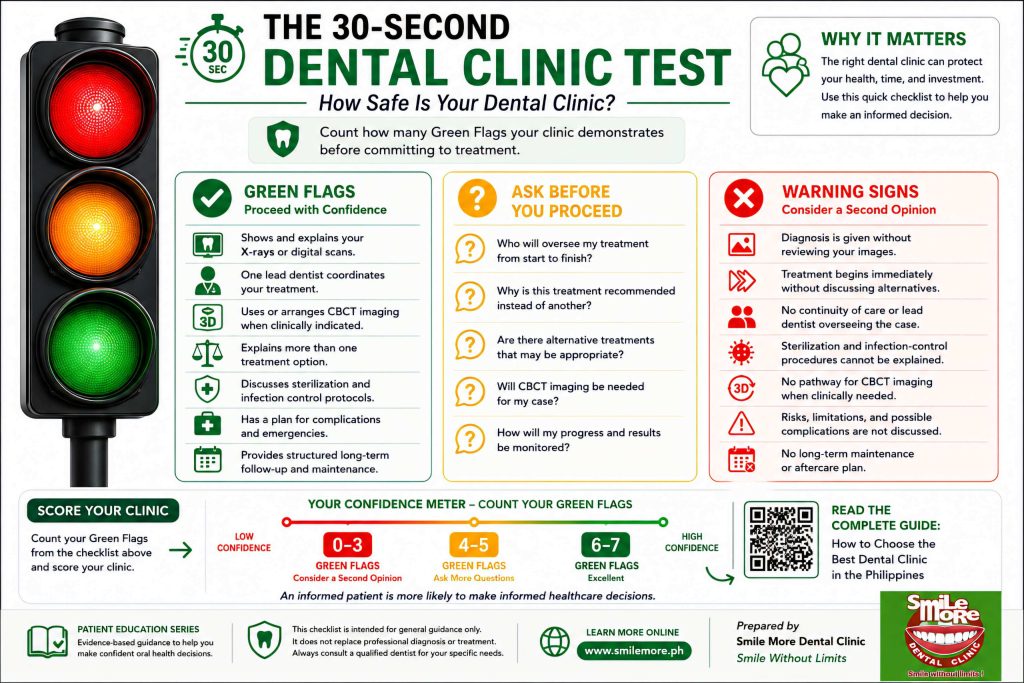
One warning sign does not prove that a clinic gives poor care. But if something feels unclear, ask before you agree to major or costly treatment.
| Watch For | What It Can Look Like |
|---|---|
You still do not understand the diagnosis | The dentist recommends treatment but does not clearly show or explain the problem. |
| You feel rushed to start | The clinic pushes you toward non-emergency treatment before you understand your choices. |
| You hear only one option | The dentist recommends one path without discussing other suitable choices when they exist. |
| You do not know who will treat you | You cannot tell who will perform each stage or who will keep track of the whole case. |
| You do not know why you need the scan | The clinic recommends an X-ray or CBCT but does not explain what it needs to show or how it will affect the plan. |
| The cost remains unclear | You do not know what the fee covers, how many stages the treatment may take, or what may cost extra. |
| No one explains what happens afterward | You leave without knowing who will check your healing, restorations, or progress after treatment. |
Bottom line: Before you agree to complex dental treatment, you should be able to answer five questions:
What is the problem? Why is this treatment recommended? What other choices do I have? What will it cost? Who will follow my care afterward?
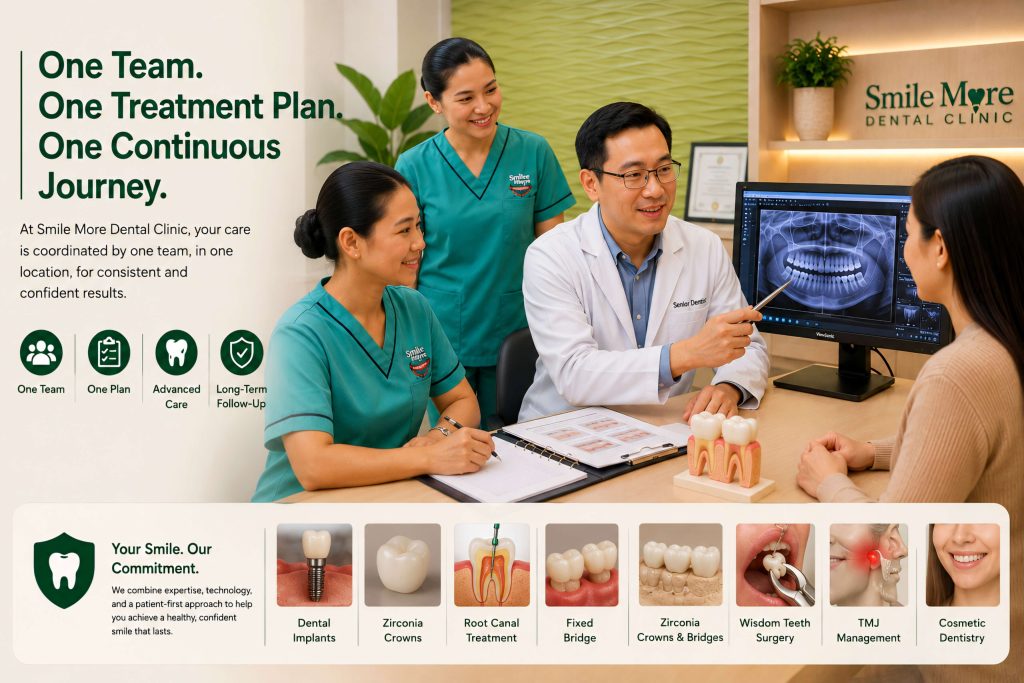
How Centralized Care Works at Smile More
| What to Check | How Smile More Handles It |
|---|---|
| Where your records stay | Smile More works from one location, so your X-rays, photos, notes, treatment plan, and follow-up stay with the same clinical team. |
| Who keeps track of the whole case | A lead dentist follows the overall plan. If another dentist or specialist handles one stage, the lead dentist keeps the rest of the case in view. |
| How the dentist chooses materials | The dentist looks at your bite, the tooth’s condition and position, and how you want it to look. Options may include zirconia, lithium disilicate, or dental resin. |
| What you know before treatment starts | The dentist explains what they found, the treatment options, the likely steps, the fees, and the care you may need afterward. |
| How the clinic gets 3D scans when needed | If your case needs CBCT imaging, Smile More arranges the scan with an outside diagnostic center and reviews it for treatment planning. |
How to read this example: Centralized care is not the only way to organize dental treatment. This example simply shows what the model can look like in day-to-day care.
Key point: One dentist does not need to perform every procedure. What matters is that your records stay connected, someone keeps track of the whole plan, and each stage leads clearly to the next.
Choosing the Right Dental Practice Model for Your Needs
The right dental clinic depends on your treatment needs, case complexity, lifestyle, and long-term oral health goals.
Choose a Multi-Branch Dental Group if:
You prioritize convenient access for routine preventive care, regular checkups, simple procedures, or flexible appointment locations close to home or work.
Consider a Centralized Dental Practice if:
You are planning complex or multi-stage care—such as dental implant treatment, zirconia restorations, root canal treatment, wisdom tooth surgery, or TMJ management—and value consistent case oversight, detailed diagnostics, and coordinated follow-up.
Where Smile More fits:
Smile More Dental Clinic in Ermita, Manila follows a centralized practice model. This approach may suit patients who prefer a consistent clinical team to coordinate complex dental care and long-term follow-up from one location.
Access to Appropriate Diagnostic Imaging
When three-dimensional imaging can provide clinically useful information—for example, in certain dental implant, impacted tooth, or TMJ cases—Smile More coordinates CBCT imaging with external diagnostic centers for treatment planning.
Key point:
Convenience matters, but it should not be the only factor. Match the clinic’s experience, diagnostic capabilities, care model, and follow-up approach to the treatment you actually need.
About this Guide: This article is based on Philippine dental regulations, professional standards, published infection-control guidance, and common patient questions. It provides a practical framework for comparing dental clinics. The clinical content was medically reviewed before publication.
Frequently Asked Questions (FAQ’s) on Finding Best Dental Care in Manila
How do I choose the best dental clinic in the Philippines?
Choose the best dental clinic in the Philippines by comparing professional qualifications, diagnostic methods, infection-prevention practices, treatment planning, continuity of care, and long-term follow-up. Rather than relying on reviews, price, or location alone, choose a clinic whose approach best matches your treatment needs.
What should I look for when comparing dental clinics?
Compare dental clinics by looking at the dentist’s qualifications, diagnostic process, communication, infection-prevention practices, treatment planning, and follow-up care. These factors provide a more reliable basis for comparison than online ratings, convenience, or advertising alone.
What makes a dental clinic trustworthy?
Trustworthy dental clinics build confidence through transparency, legal compliance, and clear patient education. They introduce their treating dentists, make professional license verification easy, use modern digital diagnostic and treatment workflows, and provide clear, itemized treatment plans without high-pressure sales tactics.
How can I verify a dentist’s PRC license?
You can verify a dentist’s professional registration through the official Professional Regulation Commission (PRC) online verification portal.¹ Enter the dentist’s full name to confirm their active PRC registration.
Is CBCT necessary before implants or wisdom teeth surgery?
Not in every case. CBCT may be appropriate for dental implant planning or complex wisdom tooth surgery when three-dimensional information about bone, tooth or root position, or nearby anatomical structures could affect diagnosis or treatment planning.⁵
What are the symptoms that indicate I might need TMJ treatment?
Symptoms can include persistent jaw pain or tenderness, clicking or popping accompanied by other symptoms, difficulty chewing, limited jaw movement, or episodes of jaw locking. A clinical examination helps determine whether further diagnostic evaluation or treatment is appropriate.
Why is continuity important for a root canal treatment?
Root canal treatment can involve several connected stages, including diagnosis, canal preparation, filling or sealing of the root canal system, and final restoration. Clear clinical records and coordination between the treating dentist, the endodontic clinician (when involved), and the restorative dentist help maintain continuity throughout care.
Should I choose the closest dental clinic?
A nearby dental clinic can be practical for routine checkups, professional cleanings, and simple procedures. For complex or multi-stage treatments such as porcelain veneers, root canal treatment, dental implants, or full-mouth rehabilitation, also consider relevant clinical experience, diagnostics, continuity of care, and follow-up when deciding how much weight to give location.
Final Takeaway
The best dental clinic in the Philippines is not always the biggest, nearest, or most visible. The better choice is the clinic that fits the treatment you need.
For routine checkups, cleanings, and simple care, location and schedule may matter most. For complex or multi-stage treatment, look more closely at who will oversee your case, how the dentist reached the diagnosis, what other treatment options exist, and who will follow your progress after each stage.
Before you commit, make sure you understand what the dentist found, why the treatment makes sense, what choices you have, and who will follow your care over time.
Choose with Confidence. Plan ahead!
Consultation appointments are frequently booked in advance.
Reserve your preferred schedule today!
Clinical Disclaimer: The information provided is for general educational purposes and should not be considered a substitute for professional dental advice, diagnosis, or treatment. Treatment recommendations should always be based on an individual clinical assessment.
Professional and Regulatory References
- Professional Regulation Commission (PRC): PRC Online Verification System
- Philippine Department of Health (DOH): Health Facilities and Services Regulatory Bureau
- Philippine Dental Association (PDA): Code of Ethics
- Centers for Disease Control and Prevention (CDC): Summary of Infection Prevention Practices in Dental Settings
- American Dental Association (ADA): Oral Health Topics – Dental X-Rays