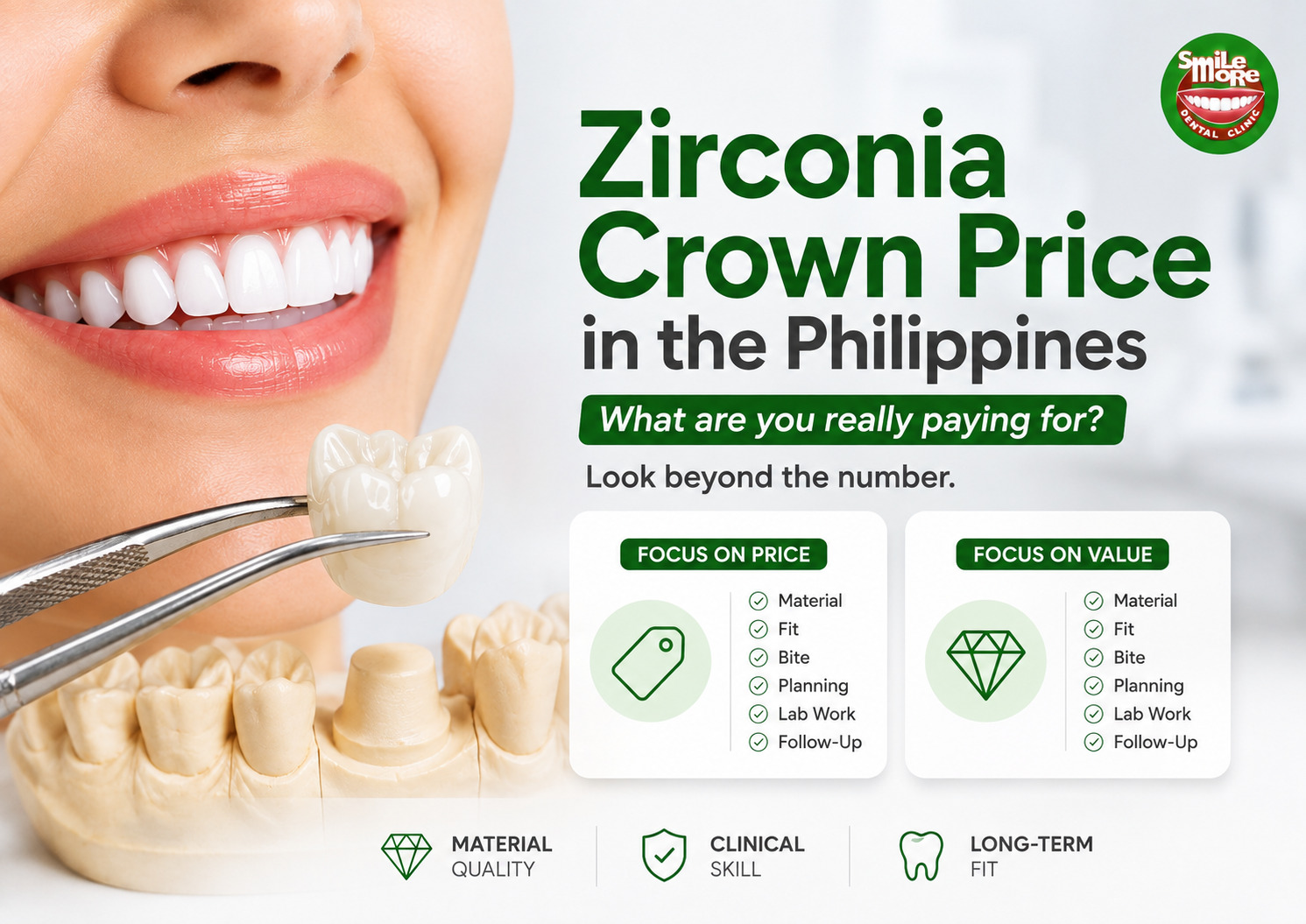
Searching for a zirconia crown price in the Philippines can feel like stepping into a pricing Wild West. One clinic gives you one figure. Another charges much more, although both quotations simply say zirconia crown.
Comparing prices makes sense. After all, one crown is already a real expense. If you need several crowns or a bridge, even a small difference per tooth can add up to a much larger bill.
But the harder question is whether two quotations cover the same work. A zirconia crown may be small enough to hold between two fingers, but behind it are the natural tooth, the dentist’s work, the laboratory, and the final checks in your mouth.
How Much Does a Zirconia Crown Cost in the Philippines?
Published 2026 Philippine price guides show a wide range for zirconia crowns. Many private-clinic quotations start around ₱20,000 and move upward, while some Metro Manila fees go above ₱40,000.
The amount can vary with the clinic, laboratory, zirconia used, treatment complexity, and what the quotation already includes.
Public dental conversations reflect this spread. Patients mention figures ranging from around ₱20,000 to ₱30,000, ₱40,000, and higher.

At a Glance: Smile More’s Current Zirconia Crown Fee
At Smile More Dental Clinic in Ermita, Manila, the current fee is: ₱35,000 (USD 560 or AUD 780).
That amount is for the zirconia crown itself. If the tooth needs separate care—such as an X-ray, root canal treatment, core build-up, or gum treatment—we explain those costs separately before treatment.
This distinction matters because two patients can receive the same type of crown but need different treatment underneath it.
The crown fee and the total cost of treating the tooth are not always the same.
Zirconia Crown Price Per Tooth at Smile More Dental Clinic
| Restoration | Current Smile More fee | What to know |
|---|---|---|
| Single zirconia crown | ₱35,000 per tooth | The dentist first assesses the tooth |
| Front zirconia crown | ₱35,000 per tooth | Shade and the teeth beside it may affect planning |
| Back zirconia crown | ₱35,000 per tooth | Bite and available space can affect design |
| 3-unit zirconia bridge | ₱105,000 | Three units × ₱35,000 |
| Implant-supported zirconia crown | Separate quotation | Implant restorative components differ |
When you compare quotations, first check whether the clinic is quoting per tooth, per crown unit, or for the whole treatment plan.
For example, one missing tooth replaced by a conventional three-unit bridge usually means three connected units, not one. We explain the bridge calculation later in this guide.
Already holding two estimates? See COMPARE ZIRCONIA CROWN QUOTES BEFORE CHOOSING A CLINIC
What Can Increase the Zirconia Crown Cost in the Philippines?
Sometimes the crown itself is straightforward. But the condition of the natural tooth can change the total treatment cost.
A tooth with enough healthy structure may need little more than preparation and the final crown. Another tooth may have deep decay, a large old filling, an unhealthy pulp, or very little natural structure left.
In those cases, the dentist may recommend separate treatment before the final crown.
Treatment That May Be Separate
| Possible separate treatment | Typical Price Range | Why the dentist may recommend it |
|---|---|---|
| Dental X-ray (periapical or digital) | ₱750–₱1,000 | To check the root, bone, hidden decay, or previous treatment |
| Old crown removal | Waived, or ₱1,500 per crown requiring cutting | Needed to examine or replace an existing crown |
| Core build-up | Case-dependent | To rebuild a tooth that has lost substantial structure |
| Root canal treatment | ₱10,000–₱17,000 | To treat inflammation or infection inside the tooth |
| Post and core (a small anchor placed inside a root-treated tooth to help the crown stay put) | Case-dependent | To add retention in selected root-treated teeth |
| Gum treatment | Case-dependent | To treat unhealthy or inflamed gums first |
| Temporary crown | ₱1,800–₱2,500 | To protect a prepared tooth between visits when needed |
These procedures should not appear automatically just because you chose zirconia.
Instead, each additional treatment should solve a problem the dentist can show or explain.
A useful question to ask is:
“What problem are we treating with this?”
That keeps the treatment plan—and the cost—connected to what your tooth actually needs.
How Do Material Choices Affect Zirconia Crown Prices?
Different ceramic designs can change laboratory time and production cost. For this reason, the zirconia crown price in the Philippines can differ even when two quotations both use the word zirconia.
Fabrication Can Change the Fee
| Material or design | Typical laboratory process | What can affect production cost |
|---|---|---|
| Monolithic zirconia | The laboratory mills, sinters, finishes, and polishes the restoration | Zirconia used, milling, furnace work, and finishing |
| Layered zirconia | The laboratory makes the zirconia structure and adds veneering ceramic | Extra ceramic work and technician time |
| Lithium disilicate / E.max | The laboratory may mill or heat-press the ceramic | Material, fabrication route, and characterization |
| PFM | The laboratory makes a metal framework and covers it with porcelain | Framework and porcelain work |
The fee difference does not rank these materials from worst to best. Instead, different ceramics require different materials, equipment, and laboratory steps.
A molar that takes heavy chewing forces and a front tooth sitting beside natural enamel do not present the same problem. The dentist may therefore choose different materials or designs even when both teeth need crowns.
For the clinical material discussion- not pricing- see How Zirconia Compares with E.Max and Layered Ceramics.
Why Can Zirconia Crown Prices in the Philippines Be So Different?
A wide difference in quotations does not automatically mean one clinic is better.
For example, lower overhead, efficient purchasing, laboratory agreements, treatment volume, or a promotion can reduce a clinic’s fee. On the other hand, a higher quotation may include more clinical time, different laboratory work, a difficult tooth, or added services.
Patients comparing fees online often ask why zirconia crown quotations can be so far apart. These discussions reveal a real patient concern. However, another person’s quotation cannot tell you what your own tooth needs.
Instead of asking only, “Which price is normal?” ask:
“What is different between these two quotations?”
That question brings the conversation back to the actual treatment.
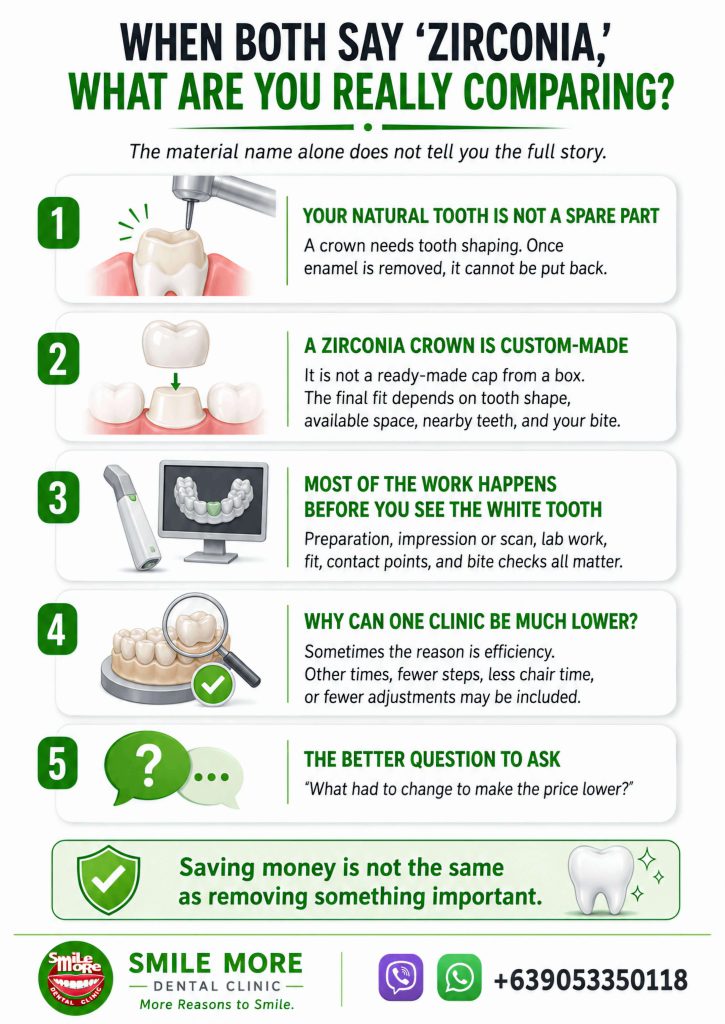
Does the Dentist Affect the Zirconia Crown Price?
Yes. The ceramic is only one part of the treatment.
A dentist still needs to examine the tooth, decide whether a crown suits it, prepare it, record it accurately, communicate with the laboratory, and check the finished crown.
A milling machine can cut ceramic with remarkable precision.
So even when two clinics use the same zirconia, the clinical work may differ.
Before the Tooth Is Shaped
First, the dentist decides whether the tooth truly needs a crown. They also check for decay, cracks, gum problems, old restorations, and how much useful natural tooth remains.
A tooth with thick natural walls does not start from the same foundation as a tooth that is mostly filling. For this reason, the dentist needs to understand what remains before removing more tooth structure.
A crown can be remade.
Natural tooth structure cannot simply be ordered again.
How the Dentist Prepares the Tooth for a Zirconia Crown
The dentist creates enough space for the restoration without removing healthy tooth structure without a reason. They also decide where the crown should meet the tooth and how clearly they can record that edge.
Think of a carpenter fitting a door into an existing frame. If the frame is shaped badly, even a beautifully made door can fit poorly.
A 2025 study found measurable differences in how much tooth operators removed at different training levels. More years of experience did not automatically produce the closest result to the ideal on every measurement.
But skill should be part of what you compare.
Why the Record and Final Check Matter
Next, the laboratory needs a clear record of the prepared tooth, its edge, neighboring teeth, and bite.
The dentist may use a digital scan or a conventional impression. A 2026 systematic review found better average marginal and internal fit with digital scanning.
A scanner can capture tiny details. But it cannot reproduce an edge that the dentist did not record clearly.
Finally, the dentist checks whether the crown sits fully, contacts nearby teeth correctly, and works comfortably with the bite before final cementation.
Price cannot measure a dentist’s skill. Still, skill should be part of what you compare.
Does Every Zirconia Crown Need Root Canal Treatment?
No.
Root canal treatment treats inflammation or infection inside the tooth. A crown restores and protects the tooth above it.
Therefore, choosing zirconia does not create a need for root canal treatment.
During root canal treatment, the dentist or endodontist removes inflamed or infected pulp. Next, they clean, shape, fill, and seal the canals inside the roots.
Sometimes a tooth needs both treatments. In other cases, it needs only one.
If root canal treatment appears on your quotation, ask:
“What finding tells you that the inside of this tooth needs treatment?”
That question helps separate the crown fee from treatment needed for the natural tooth.
What Does a 3-Unit Zirconia Bridge Cost in the Philippines?
A conventional three-unit bridge may replace one missing tooth with three connected units:
supporting crown + replacement tooth + supporting crown = 3 units
At Smile More Dental Clinic:
₱35,000 × 3 = ₱105,000
The arithmetic is simple. However, the dentist still needs to decide whether the teeth on both sides of the gap can support the bridge.
Their remaining tooth structure, roots, gum health, bone support, and bite can all affect the treatment plan.
A calculator can price three units.
It cannot examine the teeth holding them up.
For the clinical question of whether zirconia suits a three-unit bridge, see COMMON ZIRCONIA CROWN QUESTIONS BEFORE TREATMENT.
Can a Lower Zirconia Crown Price Still Be Good?
Yes.
A lower fee does not automatically mean poor materials or poor dental work.
For example, a clinic may have lower operating costs, efficient purchasing, a favorable laboratory agreement, higher treatment volume, or a temporary promotion. So, a lower quotation can have a reasonable explanation.
The same fairness applies to a higher quotation. It may reflect more clinical time, a difficult tooth, more laboratory work, or added services.
Instead of guessing from the amount, ask what the fee includes, which treatments are separate, who will prepare the tooth, and how the dentist will check the finished crown.
Lower prices can reflect efficient clinic operations, but rock-bottom promos often show their trade-offs later: a crown that feels high, catches food, looks bulky, or brings you back sooner than expected for repair or replacement—the point when the “saving” may no longer feel like a saving. See our guide to the hidden risks of cheap dental crowns.
A high price is not a halo.
An unusually low price is not a diagnosis.
For a chairside checklist, see COMPARE ZIRCONIA CROWN QUOTES BEFORE CHOOSING A CLINIC.
How Long Can a Zirconia Crown Last?
There is no exact expiry date for every zirconia crown.
A 2026 systematic review of 66 studies reported high survival for zirconia single crowns. However, researchers also found biological and mechanical complications. In other words, a crown can remain in the mouth and still need attention.
For example, the tooth underneath may develop decay, the gum may become unhealthy, or the restoration may loosen.
So, instead of asking only, “Will this crown last 20 years?” ask:
“What could shorten the life of this crown in my mouth?”
That question brings the discussion back to your tooth, bite, oral hygiene, grinding habits, and follow-up care.
Before Comparing Zirconia Crown Prices
The price should start the comparison, not end it.
Before choosing between quotations, check five things:
- Is the fee per tooth or per unit?
- What does the quotation include?
- Which procedures are separate?
- Who will prepare and fit the crown?
- What could make the final amount change?
Then compare the plans again.
You may discover that the lower quotation gives you exactly what you need. Or you may find that the higher quotation already includes work that the other clinic lists separately.
Sometimes the dentists are not even proposing the same treatment.
That is what a useful comparison should uncover.
Understand the Cost Before You Commit
The crown fee is only one part of the treatment plan. If the tooth needs other care first, this can add to the total cost.
We can examine the tooth, explain what is included, and discuss any additional treatment before you decide.
Planning a Zirconia Crown or Bridge?
Bring any recent X-rays, previous crown records, or root canal information you have. We can review the tooth, the treatment plan, and the costs that apply to your case.
Need help understanding the zirconia crown cost?
We can assess the tooth, explain what the crown fee covers, and clarify any separate treatment before you decide.
Book a consultation at Smile More Dental Clinic for a clearer treatment plan and cost breakdown
Frequently Asked Questions About Zirconia Crown Cost in the Philippines
1.) What Is the Zirconia Crown Price in the Philippines?
Private-clinic fees vary. Published 2026 guides show a broad market, while Smile More Dental Clinic currently charges ₱35,000 (~USD 560 / AUD 780)per zirconia crown unit.
2.) Why Does the Zirconia Crown Price Vary Between Clinics?
Clinics may use different laboratories, workflows, equipment, and inclusions. Also, the condition of the natural tooth can create separate treatment costs. Therefore, a higher or lower fee does not automatically tell you which treatment is better.
3.) Why are some zirconia crowns cheaper?
Lower operating costs, laboratory arrangements, purchasing rates, promotions, or fewer included services can lower a quotation. A lower price alone does not prove poor treatment. However, when a price seems too good to be true, it often leaves out critical preparation steps or uses substandard blocks. See our breakdown on what you risk with cheap dental crowns.
4.) What Can Be Separate From a Zirconia Crown Fee?
The dentist may separately recommend an X-ray, root canal treatment, core build-up, post, gum treatment, temporary crown, or another procedure when the tooth needs it. However, each treatment should solve a specific dental problem rather than appear automatically because you chose zirconia.
5.) Does Every Zirconia Crown Need Root Canal Treatment?
No. Root canal treatment treats disease inside the tooth, while a crown restores the tooth above it. Therefore, choosing zirconia does not automatically mean the tooth needs root canal treatment.
6.) Does a Higher Zirconia Crown Price Mean a Better Crown?
Not automatically. A higher fee may reflect different laboratory work, more clinical time, or added services. However, price alone cannot measure tooth preparation, fit, bite, or dentist skill.
7.) How Much Is a 3-Unit Zirconia Bridge at Smile More?
At ₱35,000 per zirconia unit, three units total ₱105,000.
Yet the dentist must first examine the supporting teeth. Any separate treatment those teeth need can change the final total.
Disclaimer:
This page provides general patient education and price-planning information. It does not diagnose a tooth or guarantee that zirconia suits a particular case.
Fees and clinic policies can change. Therefore, the dentist must examine the tooth and review the appropriate records before confirming the restoration, number of units, and any separate treatment.