We take or request X-rays for the following reasons:
1. Find Out If There Is Decay Between Teeth
Sometimes it is hard to see with the naked eye.
2. Check for Bone Loss
An x-ray presents noticeable jaw bone loss associated with gum disease.
3. Check for Decay Under Fillings
An x-ray will help us see the underlying problem with dental restorations.
4. Look for Infection at the Tip of the Root
An x-ray will guide us to confirm the presence or absence of infection.
5. Examine the Area Before Procedures
Gives the dentist a detailed view of teeth and bone, avoiding guesswork.
When we recommend that we need to take or request a Dental X-ray, we intend to better evaluate your dental status or problem. So, our dentist can implement a reliable treatment solution.
Dental X-rays come in various forms, each serving a specific purpose to provide detailed insights into your oral health:
Bitewing X-Rays:
Ideal for checking decay between teeth and evaluating bone levels.
Periapical X-rays:
Focus on the entire tooth, from crown to root, to detect infections or root fractures.
Panoramic X-rays:
Provide a complete view of the entire mouth in one image, commonly used for surgeries or orthodontic assessments.
Cone Beam CT Scans:
Provide 3D imaging for precise planning of implants, extractions, or other complex procedures.
These X-rays ensure a comprehensive diagnosis, helping our dentist provide the most effective and accurate treatment. Our focus is on minimizing radiation exposure while delivering the clearest possible images for optimal care.
At Smile More Dental Clinic, we provide Dental Cleaning to help maintain the patients’ gum health and promote overall wellness.
Even if you brush and floss your teeth regularly, it might not be enough to keep them clean for a long time. A dental plaque can still develop near the neck of the teeth, reaching deeper below the gum line and in between them. This hardened plaque is full of bacteria that can cause gum bleeding and inflammation, a sign of gum disease if left untreated. Not only are they unsightly, but they can also cause the jaw bone to deteriorate and emit a lousy breath.
When cleaning teeth, we use an Ultrasonic Scaler, a device designed to remove disease-causing teeth deposits.
We sometimes have to scale teeth manually with a hand instrument called a “scaler,” which can reach narrow areas between teeth and the far corners of the mouth that are hard to clean with the ultrasonic scaler.
Next, we’ll use a rotary brush with a grainy prophylaxis paste to polish the teeth, followed by dental flossing. The procedure usually takes 15 minutes to an hour, depending on how much plaque and tartar are on the person’s teeth.
The price for the professional teeth cleaning service depends on how much plaque has built up and how long it will take to clean.
In our clinic, we have classified the plaque build-ups as light, moderate and heavy status:
1.) For light-degree plaque
They are the cheapest to do. You probably won’t see many tough deposits if you brush your teeth regularly. If you keep up with regular dental cleanings, your dental plaque degree will be classified as light.
2.) Moderate thickness of hardened plaque
when you can see a noticeable amount of dental plaque on your teeth. Dental plaque can stick to your teeth more easily if you have acidic saliva, rough or irregular tooth surfaces, frequent eating habits, or if your teeth are naturally predisposed to plaque buildup.
3.) Heavy classified teeth calcular deposits
Harder to remove and take much longer to clean. Let’s say you smoke a cigarette, drink teeth-staining drinks (coffee, tea, colas, etc.) and eat a lot of colored food. You’re likely to get more dental calcular deposits (tartar). If that’s the case, the teeth cleaning price won’t be the same as the two previously mentioned classifications.
We believe that preventive care is vital for keeping good oral health. Our goal is to keep our patients as healthy as possible. The best approach we have been doing for years is by doing thorough dental care and teaching our patients how to do good routine oral maintenance at home. Do not be ashamed if you haven’t seen your dentist for a long time and feel that you have many plaques or deposits on your teeth. We understand that a particular reason may cause such delay. Still, we can assure you that we have helped individuals in the same situation and good enough that they could get back their gums and teeth to health. If you live in the greater Manila area, Pasay, Makati, Paranaque, Quezon City, or stay in the nearby cities, call (632) 8 254-3773 to schedule your dental exam and stay healthy year-round.
The usual recommended frequency for Professional Dental Cleaning (Oral Prophylaxis) is every 6 months. Oral Prophylaxis is the first vital solution to destroy harmful plaque and bacteria that cause gum disease and tooth decay. If left to stay on your teeth, the dental plaque and deposits consist of bacteria that are believed to be toxic to gums and exposing you to further health risks.
Take Control of Your Oral Health Today
At Smile More Dental Clinic, we focus on delivering outstanding care designed to meet your specific needs. Whether you’re booking your first checkup, considering treatment options, or maintaining your dental health, our team is ready to assist you.
Come see us in Ermita, Manila, and take the first step toward a brighter, healthier smile.
Book your dental checkup and begin your path to excellent oral health.
The most common service done in our clinic is dental fillings. They are intended to restore or repair the decayed, damaged, or chipped tooth into a healthy and functional form, as it was before.
How do we do Dental Filings?
1.) Checking and evaluating each tooth to be filled whether dental fillings are a suitable solution. We require X-rays if restoring multiple teeth or for questionable teeth status.
2.) Typically for shallow and superficial dental cavities, local anesthesia may not be necessitated. For deep and complex tooth decay, or when the patient is not comfortable – we can put the tooth to numb.
3.) We prepare the tooth to receive a dental filling, carefully removing the blackened or decayed part. We emphasize doing this part because just preparing the tooth without really removing the rottenness will not treat the decay. Bacteria can still eat up the underlying structure and eventually recur into a more extensive decay and tooth disintegration. A learned dentist knows that the cavity preparation design box should incorporate a retentive design for the dental filling to be holding efficiently.
4.) When we are sure that all the decay is removed, we wash and clean the prepared tooth using a water syringe, then dry it.
5.) Suppose the prepared hole is shallow. We apply an etching solution that will do micro-holes on the borders of the preparation for added tooth filling retention. This solution does not have a pleasing taste, and sometimes you taste them by chance. Just spit it away, do not swallow, and we will wash it out anyway.
6.) A deep and complex dental cavity requires inner protection. We all know that the tooth is a living tissue that can sense pain or sensitivity. This is when we put a nerve protection, called cavity base. The reliability of the finished dental filling will rest on the condition that future distress can be avoided if the inner structure has been protected. Using this added dental material will safeguard the underlying nerve, so we emphasize that they be put if required.
7.) Using a special glue called a bonding agent, we apply this to the prepared surface, and then we use a Light-cure device that makes it bonded to the tooth. This is the lock that secures the filling to the tooth, as you might wonder why the dental filling is gripped that way to the repaired tooth.
8.) The bulk of the filling is the Composite Resin material or the Tooth-Colored Filling that we customarily use. We have to be sure that they are adequately packed, with no voids underneath, and sealed accordingly. Again, the Light-cure emitting light device will cause this filling to harden.
9.) We require a molder or thin metallic matrix band for molars for complex dental cavities when using Amalgam Fillings and Celluloid Strips when using Composite (White) Fillings. This is essential for good packing and avoiding the filling from sticking to the adjacent teeth for Composites.
We can repair a broken or dislodged filling, like in cases of recurrent decay. Still, a careful review of the tooth’s health status and vitality is essential if saving the tooth and avoiding future problems is the goal. For broken fillings, time is crucial because the longer you wait, the less chance for better tooth mending.
10.) We aim to always put the dental filling material on the tooth without saliva contamination. We very well know that bacteria from the saliva can be incorporated into the process. So, aside from the saliva suction machine, we put a cotton roll next to the tooth being filled in.
11.) Finally, using a thin carbon paper mark indicator, we check for the correctness of the bite. Excess or high portions must be trimmed and polished as it can take a toll on the longevity of the dental filling. Polishing the completed filling is essential so that the tongue will not feel some nuisance when it passes through the filled tooth.
Having read the description above, you might agree that requiring a dental filling is no simple task. The experienced dentists of Smile More Dental Clinic (Manila), equipped with knowledge and understanding of the tooth condition, will further explain if dental fillings are a treatment option. For sure, they will advise you if this is the ideal solution for your situation.
These are the commonly used dental fillings we offer in our clinic. The above description is particularly applicable to this type of dental filling. It is generally done in one visit. When choosing this option, one thing to consider is enough or substantial tooth structure to carry the load of restoration material. However, there are limits on how many dental cavities we can cover during the patient’s visit. Depending on prior agreement, patient’s tolerance, available time, budget consideration, and other factors – we can do a minimum of 2 dental fillings or more.
The durability and toughness of this filling will depend on a lot of factors:
Technique and skills of the dentist considered.
The quality of dental filling materials being used (which you can count on us, as we continually invest in tried and tested brands).
The tooth’s condition, whether highly savable or marginally risked.
Food consumptions habit of the patient (sweets, candies, junk foods, hard foods, etc.) are known to jeopardize dental fillings permanency.
And fewer accidents that possibly can happen
Temporary or Provisional Fillings
this is the material we advise to use if the dental cavities are too deep, that it is almost reaching the nerve. This cement- medicament has a therapeutic effect on the irritated tooth nerve, preventing dental pain and tooth becoming infected, which may require other services, like Root Canal Treatment or Extraction. There is, however, no guarantee if this treatment can keep the badly damaged tooth from becoming infected. Despite our best effort to preserve the tooth, if the dental nerve is already involved or bacteria has gotten their way inside, the tooth filling can eventually fail.
You have to be on guard against your dental health issues, especially tooth cavities. The sooner you see us for assistance, the bigger chance you have to save your valued teeth.
The price for dental fillings at Smile More Dental Clinic in Ermita, Manila, depends on the extent of the dental cavity to be done. We usually charge them on a per surface basis. We mentioned above that we sometimes use a cavity base (or cavity liner) on deep cavities to protect the sensitive part of the tooth. If needed, we use them with extra cost.
We always recommend taking an X-ray when restoring a tooth cavity, especially the deeper ones. We need to assess how far they have affected the tooth or how close to decay has gotten near the dental nerve. With X-ray as a guide, it gives us more precision on preparing the teeth and caution not to involve the nerve.
Fixing a cavity from a filling and fixing it, again and again, is not a long-term solution. Some huge dental fillings fail, and more cavities will be gained if left that way. Because as the hole gets bigger, the remaining tooth structure becomes a lot weaker or brittle. Asking us to put a dental filling when it is not advised is never encouraged because you will only postpone the damage and the problem.
Amalgam Dental Fillings
This is the type of dental fillings that were popular back then. We had the experience of doing them, and based on what we have observed — they can survive for many years. We still see them among patients. There is a controversy on mercury being unsafe and some undesirable effects of Amalgam Fillings. But in hindsight, Amalgam Filling is not the mercury itself – it is a mixture of metal alloy and mercury mixed, and excess mercury is taken out. Amalgam fillings are known for their ease of use, strength, durability, and longevity; that is why this was the standard before and are still used in some places.
Inlays and Onlays
Some occasions may require this type of solution for filling the tooth. If the prepared dental cavity is huge and putting a Composite Dental Filling is an unlikely option, this is where we offer this choice.
An inlay is intended for moderately-sized or even bigger cavities, with a remaining tooth wall of the prepared cavity that will contain it. While the inlay can extend to even more extensive damage, even involving the lost wall of the cavity and tooth cusps (the pointed part that hits the opposing teeth for chewing, usually subjected to high stress).
If the damage is too severe, it is more practical to opt for a dental crown for a reliable outcome.
Inlays and Onlays come in different forms: Ceramics, Metal, or Gold.
Because we always want to provide patients with a feasible solution, we sometimes do “Indirect Pulp Capping.” The purpose is to keep the tooth nerve vital or alive. This is possible when the bacteria has not reached or infected the dental nerve yet. We put a medicament and used a definitive or provisional filling, observing the repaired tooth for a given period, then replacing it with a durable filling material.
Dental Decay Symptoms:
Noticeable holes or pits on the tooth’s biting surface
Mild to moderate teeth sensitivity
Tounge notices sharp area where food particles get stuck in
Uneven discoloration on teeth surface or old fillings (recurrent decay)
Toothache that happens without apparent cause
Abrasions on the neck-line of the tooth, sometimes caused by improper brushing
Mild to acute pain when drinking or eating
Food particles often getting caught in the same area.
FREQUENTLY ASKED QUESTIONS (for Dental Fillings):
When Do I Need a Teeth Filling?
Patients need a dental filling when bacterial tooth activity damages or rotten their teeth. Since dental cavities are dental problems created by bacteria found in plaque (they are also responsible for tartar formation) that gather on and around the tooth. These microbes flourish on sweet foods that we consume. If not adequately cleaned or removed by tooth brushing, bacteria secrete an acidic substance that weakens the tooth’s hard covering — creating a hole or cavity in the tooth. If not treated, they can eat up more teeth surfaces until sensitivity or discomfort is experienced. Compared to other dental services, this one is considered a cheap and affordable dental clinic’s service.
Dental caries usually never felt sensitive or incite pain when tooth decay is still shallow. That is why many patients don’t even realize that they have an ailing tooth until later, in the further advanced stage of tooth decay, when the hole gets deeper. Cavities start to form in places where food debris gets trapped, such as the teeth’ irregular pits, or gaps between teeth, making them even harder to detect. Frequent dental visits allow the dentist to check and spot tooth decay in the initial stages, allowing us to treat the problem before they cause severe destruction on the teeth.
Likewise, for kids and some adults, we advised that these “pits & fissures” cavity-forming occurrence be controlled by using preventive “dental sealants” that our clinic also advocates using.
What can I expect when getting a Dental Filling? Will it Hurt?
Some level of discomfort will have to be experienced when receiving a dental filling. For shallow dental decay, usually, no sensitivity to the procedure is felt. Each patient has a varying degree of tolerance to getting the tooth prepared, cleaned, and decay removed. We have noted that most patients find the tooth drilling bearable, depending on the patient’s depth of decay and pain threshold, as this may vary. A local anesthetic is available on request of the patient for pain-free dental filling treatment.
Why is it necessary to fill up tooth decay with a tooth-filling material?
If left unattended, dental cavities will progress and continue to destroy the remaining tooth structure. As it goes, the decayed tooth part will more so be exposed to food particles getting caught in the decay, allowing more bacteria and food debris to thrive. The spread of the damage can involve:
The enamel (outermost covering of teeth).
The dentin (the second tooth layer that has nerve endings).
The dental pulp (inner tooth nerve).
When the dental pulp becomes irritated, intense toothache becomes a daily occurrence. It can only be resolved through a Root Canal Treatment, which is a lot more costly than a dental filling or tooth extraction, resulting in tooth loss.
Patients are advised to have their dental cavities filled the soonest to stop them from spreading to nearby or adjacent teeth. Tooth decay is a disease process caused by bacteria with acidic tendencies creating decay or holes to the predisposed teeth.
How Many Years Do Fillings Can Survive?
Dental fillings are not meant to last forever and will need to be replaced. A usual Composite Dental Fillings materials (tooth-colored) may last up to 5 to 7 years or more before being replaced. Silver Amalgam Fillings last longer, up to 10 years or more, before needing to be replaced. But in our clinic, we noticed that patients who frequently see us for a regular check-up could keep their dental fillings much longer because we can give them a quick fix when we notice some level of deterioration.
Inlays and Onlays can last the longest with proper dental care, lasting up to 10 years or more before needing replacement.
*Above figures are only estimated and do not reflect all cases. Each patient and their situation is different. As such, the lastingness of which how long each filling may endure will differ from patient to patient.
Reasons for Replacing Previous Dental Fillings:
Failing or broken-down filling
Discolored and tarnished filling
Recurrent decay
Take Control of Your Oral Health Today
At Smile More Dental Clinic, we focus on delivering outstanding care designed to meet your specific needs. Whether you’re booking your first checkup, considering treatment options, or maintaining your dental health, our team is ready to assist you.
Come see us in Ermita, Manila, and take the first step toward a brighter, healthier smile.
Book your dental checkup and begin your path to excellent oral health.
Dental sealants are dental preventive procedures intended to protect and cover the chewing surfaces of back teeth (molars and premolars). With the use of dental sealants, we can shield the permanent teeth untouched by tooth decay to have a solid layer of protection. They are thin plastic coating, white or teeth-colored materials highly efficient tooth sealers. Most dental decay that occurs among children and young adults happens on the back teeth (premolars and molars) “pits and fissures.” Such areas are rough and impassable by a toothbrush; that is why plaque and bacteria can stay on these crevices. Sealants are safely proven dental procedure that gets in the way against a bit of food, plaque, and bacteria. That without a shield-like covering, the tooth can eventually get tooth decay.
We noticed in our clinic that those patients who did not have dental sealants applied on chewing surfaces of their teeth could likely get tooth decay. They end up receiving a dental filling or lost their molars at an early age—knowing that most comfort food that kids and young adults eat are mostly sweets, processed foods, and junk foods. Without sealant protection, the odds of catching dental decay from that unhealthy food consumption are high. When we put dental sealants at an early age, soon after the permanent teeth erupt, tooth decay can be avoided — save you money in the long run. Instead of bacteria attacking the tooth structure, the dental sealants placed on the grooves of teeth chewing surfaces of back molars protect them from digging rotten holes.
Though sealants are a practical solution, they are no substitute for brushing and flossing that we need to do at least twice a day or every after each meal. We constantly mention to our patients to observe good dental hygiene at home. Besides flossing and brushing, anti-cavity mouthwash can do benefit by keeping your mouth fresh.
Prevent plaque and bacteria from nestling on the irregular teeth crevices, like pits and fissures. Let us stop them from destroying your teeth usingdental sealants.
Fluoride Treatment or Fluoride Application
Is proven to be a quick and effective way of arresting dental decay among children and can also work on susceptible adults. Fluoride is a mineral significantly tested to defy the cavity-forming effect of plaque and harmful mouth bacteria. When applied, fluoride establishes a bond to the tooth’s inorganic structure, resulting in a tougher composition, resisting decay from forming. This effect is possible because they are proved to be effective in neutralizing bacterial action’s acidic tendency.
We do Dental Fluoride Treatment at Smile More Dental in Ermita, Manila, by applying dental fluoride in gel or varnish. We found Professional Fluoride Treatment helpful in decreasing the spread and occurrence of dental caries in children and adults in the same way.
This dental upkeep benefits our patients by improving dental health and hamper the least forthcoming dental treatment, like fillings and extractions. We recommend Fluoride Treatment as soon as children’s permanent teeth have erupted to enable the fluoride to be integrated into their tooth structure. We likewise recommend them applied to adults with high caries hint or for those who simply want their teeth given an added protection tier. Patients may require the application of fluoride every six months or depend on their specific needs.
Our dependable dentists at Smile More Dental Clinic in Ermita Manila ensure that an adequate level of fluoride is applied to your teeth because this will successfully cease the breakdown of your teeth’ enamel caused by the bout of caries-producing bacteria.
Fluoride application and regular brushing and flossing help reduce dental caries in children and benefit adults by reinforcing their teeth against caries attack.
We aim to effectively negate and offset tooth decay from forming so you can have strong and intact teeth. Help yourself preserve your teeth in their best form by receiving Fluoride Treatment here at Smile More Dental Clinic.
Take Control of Your Oral Health Today
At Smile More Dental Clinic, we focus on delivering outstanding care designed to meet your specific needs. Whether you’re booking your first checkup, considering treatment options, or maintaining your dental health, our team is ready to assist you.
Come see us in Ermita, Manila, and take the first step toward a brighter, healthier smile.
Book your dental checkup and begin your path to excellent oral health.
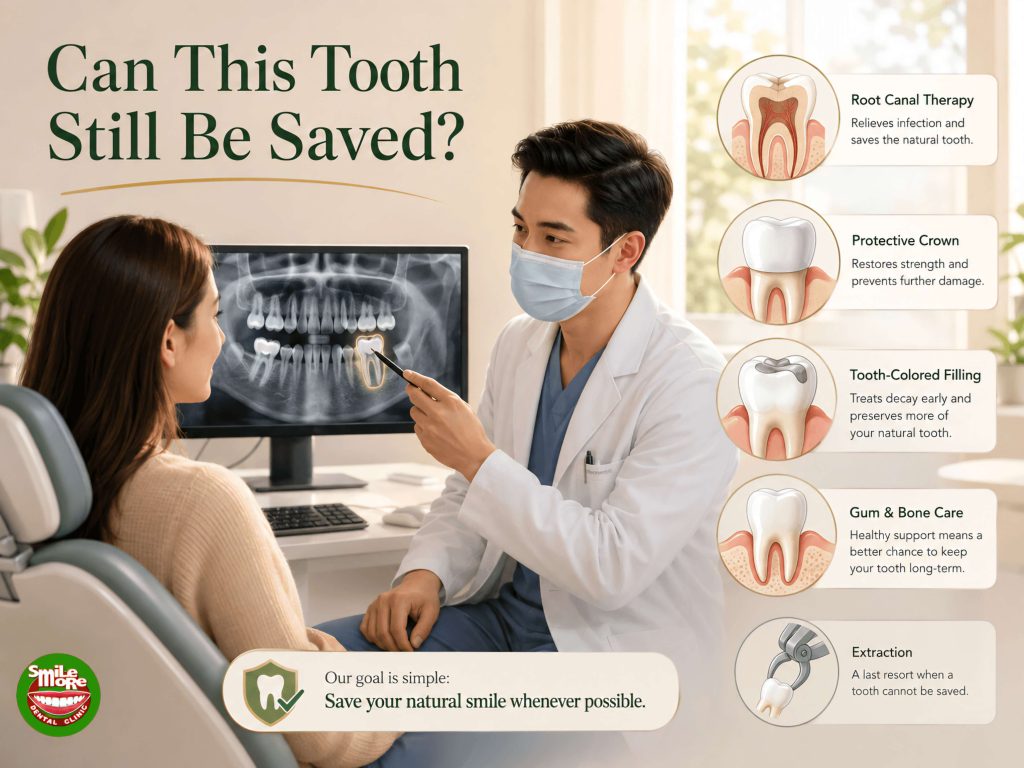
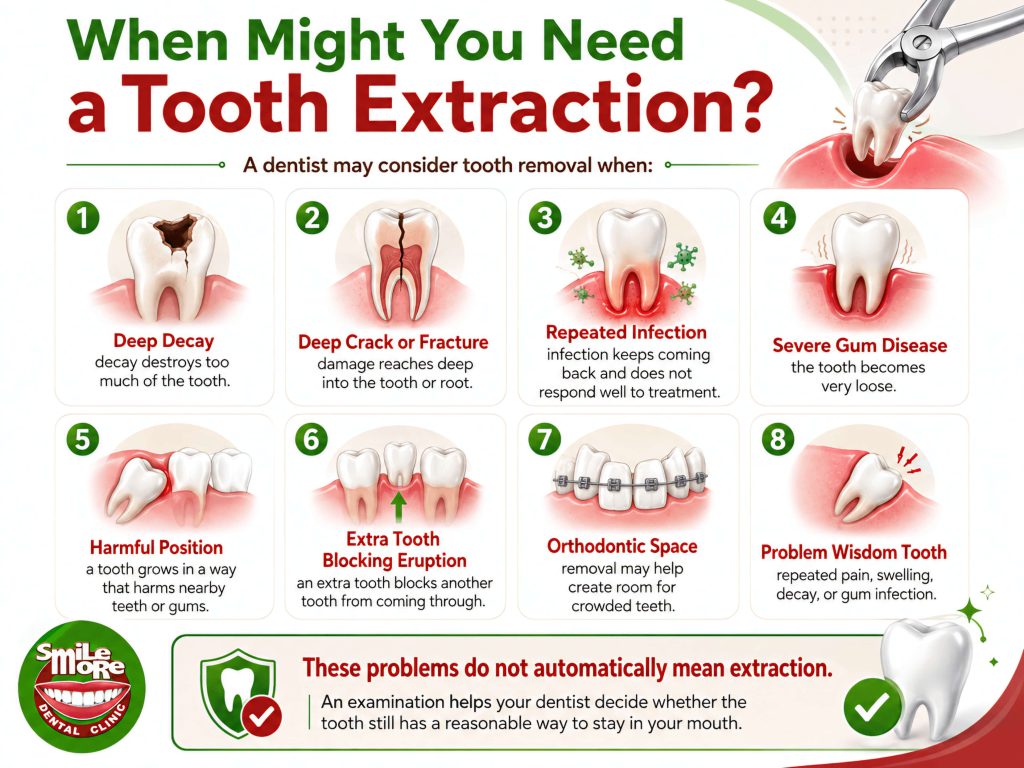
A painful, broken, or infected tooth does not always need to come out.
Whenever possible, your dentist should first check whether treatment can still save it. A filling, root canal, crown, or gum treatment may extend the tooth’s useful life.
However, some teeth become too damaged, loose, infected, or difficult to restore.
If a tooth has a poor prognosis, your dentist does not expect it to stay healthy or useful for long. Keeping it may lead to more pain, swelling, infection, or damage to the nearby gums, bone, or teeth.
In these cases, tooth extraction may offer the better long-term option.
If you are considering tooth extraction in Manila, we first examine the tooth and understand the problem before planning removal.
a crack or fracture reaches deep into the tooth or root;
infection keeps returning, and the tooth cannot respond well to treatment;
severe gum disease leaves the tooth very loose;
a tooth grows in a position that harms nearby teeth or gums;
an extra tooth blocks another tooth from coming through;
an orthodontic plan needs more room to move crowded teeth; or
a wisdom tooth can cause repeated pain, swelling, decay, or a gum infection.
These problems do not automatically mean extraction.
An examination helps your dentist decide whether the tooth still has a reasonable way to stay in your mouth.
Simple or Surgical Tooth Extraction?
Not every tooth extraction uses the same method.
For tooth extraction in Manila, the right approach depends on the tooth, its roots, and the bone around it.
A tooth may look easy to remove above the gum. However, an X-ray may show curved roots, bone over the tooth, or a root that sits deep below the gum.
These details help your dentist decide between a simple extraction and a surgical extraction.
What to Compare
Simple Extraction
Surgical Extraction
Usually used for
A tooth the dentist can see and reach above the gum
A tooth or root that sits partly or fully below the gum or bone
Common example
A loose tooth or a tooth that has fully come through the gum
An impacted tooth, a badly broken tooth, or a root left under the gum
What the dentist does
Loosens the tooth and removes it
May open the gum, remove a small amount of bone, or divide the tooth into smaller pieces
Stitches
Often not needed
May be needed to hold the gum in place while it heals
An impacted tooth is a tooth that cannot fully come through the gum. Part or all of it may remain trapped under the gum or bone.
A surgical extraction does not mean that something went wrong. In some cases, the tooth’s position, roots, or surrounding bone makes surgery the safer way to remove it.
If you are planning a tooth extraction in Manila, it helps to know what happens during the procedure.
Read our Tooth Extraction Procedure Guide: Simple vs Surgical Extraction.
Need Tooth Extraction in Manila?
You cannot always tell by looking at the tooth.
An examination and the right X-ray can help us see what sits below the gum before we plan treatment.
Book a Tooth Extraction Assessment
Thank you for your patience. Our schedule often fills early, so booking ahead helps.
Decide whether a simple or surgical approach suits the tooth.
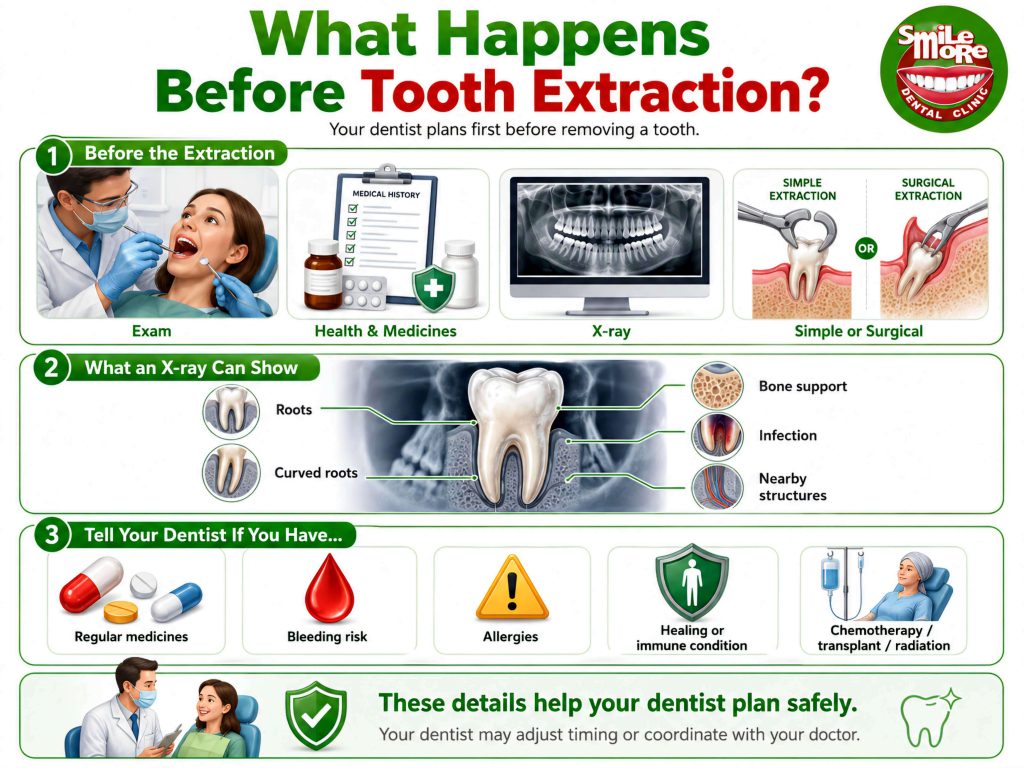
An X-ray can reveal details that your dentist cannot see inside the mouth, such as:
how many roots the tooth has;
whether the roots curve or spread apart;
how much bone surrounds the tooth;
whether infection sits around the root; and
how close the tooth lies to nearby structures.
These details help the dentist plan the extraction before treatment starts.
Tell Your Dentist About Your Health and Medicines
Your health can affect dental treatment.
Tell your dentist if you:
take regular medicines;
use medicines that affect bleeding;
have allergies;
have a medical condition that affects healing or immunity; or
plan to undergo chemotherapy, organ transplantation, or head and neck radiation.
These conditions do not automatically mean you need an extraction. However, your dentist may need to adjust the timing of treatment or coordinate with your doctor..
What Happens DURING a Tooth Extraction?
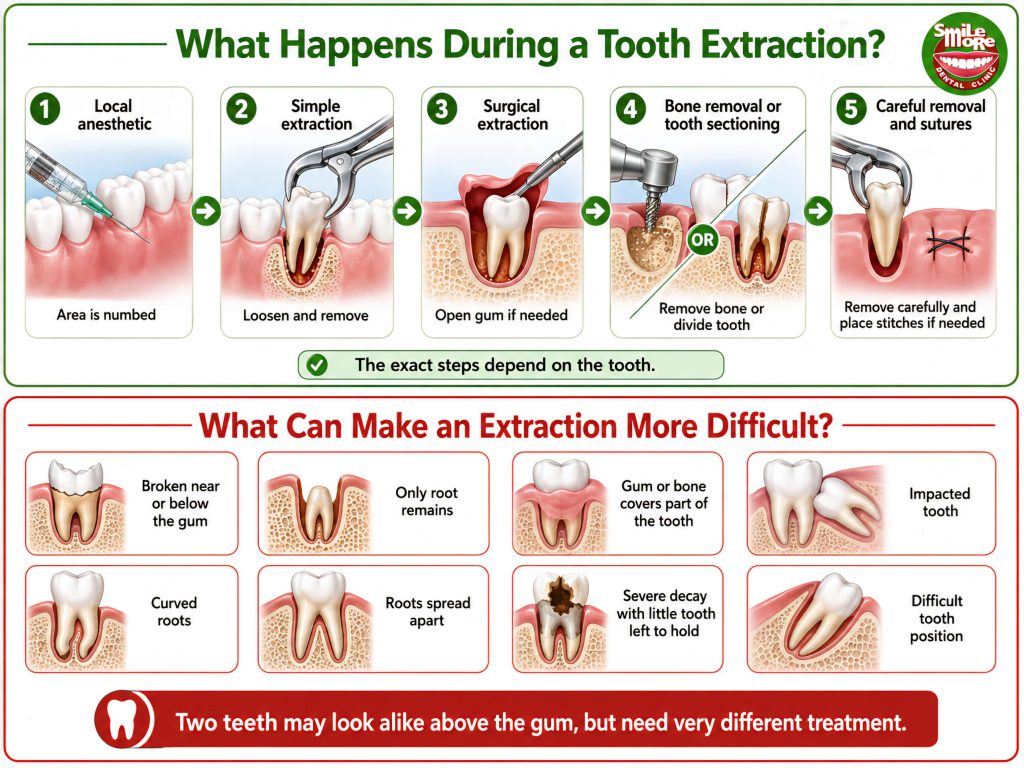
First, the dentist uses a local anesthetic to numb the treatment area while you stay awake.
For a simple extraction, the dentist gently loosens the tooth and removes it from its socket—the space in the jawbone where the tooth sits.
A surgical extraction may require extra steps.
For example, the dentist may:
make a small opening in the gum;
expose part of the tooth or root;
remove a small amount of bone when necessary;
divide the tooth into smaller sections;
remove each section carefully; or
place sutures, the dental term for stitches, when needed.
The exact steps depend on the tooth.
See what happens step by step in our Tooth Extraction Procedure Guide.
What Can Make an Extraction More Difficult?
A tooth may need more planning when:
it breaks close to or below the gum;
only a root remains;
gum or bone covers part of the tooth;
the tooth remains impacted;
the roots curve sharply;
the roots spread far apart;
decay leaves little tooth for the dentist to hold; or
the tooth sits in a difficult position.
Two teeth can look alike above the gum. But their roots and surrounding bone may make one harder to remove than the other.
A difficult extraction does not always mean something went wrong.
Sometimes, the tooth was difficult from the start. Its roots, position, or the bone around it may call for a surgical approach.
In that case, surgery is not a setback. It is simply the right way to remove that particular tooth.
What Happens After Tooth Extraction?
Once the tooth comes out, your body starts forming a blood clot inside the socket.
That clot protects the area while early healing begins.
During the first stage of recovery, you will usually need to:
keep pressure on the gauze as instructed;
protect the blood clot;
eat soft foods;
avoid disturbing the extraction site;
keep your mouth clean without irritating the wound; and
follow your dentist’s instructions for medicines and activity.
Some bleeding, swelling, and tenderness can occur after treatment.
However, good aftercare matters because disturbing the blood clot can slow healing.
Read ourTooth Extraction Aftercare Guide for food, cleaning, swelling, bleeding, and healing instructions.
What About Wisdom Tooth Extraction?
Not every wisdom tooth needs removal.
However, a wisdom tooth may cause trouble when it:
stays trapped under gum or bone;
repeatedly causes pain or swelling;
develops decay;
traps food around the tooth beside it; or
damages nearby teeth or gums.
An impacted wisdom tooth often needs different planning from a routine extraction.
Frequently Asked Questions (FAQ’s) for Tooth Extraction
1. Does every painful tooth need extraction?
No. Pain can come from several problems, and some teeth can still respond to treatment. Your dentist needs to examine the tooth before deciding.
2. How do I know if I need a simple or surgical extraction?
The amount of visible tooth, root shape, position, surrounding bone, and other factors help determine the approach.
3. Does tooth extraction hurt?
The dentist uses local anesthetic to numb the area during treatment. You may feel pressure or movement, but tell the dentist if you feel pain.
4. Will I need an X-ray before extraction?
That depends on the tooth and the case. Imaging can help the dentist examine roots, bone, infection, and nearby structures before removal.
5. Do all extracted teeth need replacement?
No. The answer depends on which tooth comes out, your bite, chewing needs, appearance, and the condition of nearby teeth.
6. How long does a tooth extraction take to heal?
Healing happens in stages and varies with the type of extraction and the patient. → Read our Tooth Extraction Aftercare Guide.
Disclaimer: This page provides general information about tooth extraction and does not replace a dental examination, diagnosis, or treatment plan. Every tooth and patient is different. A dentist may need to examine your tooth and review an X-ray, your symptoms, and your medical history before recommending the right treatment.
Before You Decide on Extraction
Find out whether the tooth can still be saved or if extraction is the better option.
Our schedule often fills early, so booking ahead helps.
Does cleaning damage my teeth? No, it doesn’t. Our teeth care providers at Smile More Dental Clinic use safe and gentle tools to protect your enamel while removing plaque and tartar.
“Many patients worry about professional dental cleanings harming their teeth,” says Dr. Richard Liao, our lead dentist at Smile More. “Our ultrasonic scalers are specifically designed to target only tartar and plaque, not the enamel. Your enamel is tough, and our tools work safely to maintain its strength and integrity.“
At Smile More Dental Clinic, we offer dental cleaning in the Philippines to keep your gums healthy and promote overall wellness. Even if you brush and floss daily, it may not be enough. Plaque can still form near the neck of your teeth, reaching deep below the gumline and between them. This hardened plaque contains bacteria that cause gum bleeding and inflammation—early signs of gum disease. This condition can affect the jawbone and cause bad breath if taken for granted without care.
Dental Cleaning or Oral Prophylaxis isn’t just about a bright smile; it’s about keeping your mouth and entire body healthy. Regular cleanings(Teeth Scaling and Polishing) prevent:
Cavities: Removing plaque stops acids from eroding enamel.
Gum Disease: Cleanings keep gums healthy and reduce the risk of infections.
Tooth Loss: Untreated gum disease can damage bone structure, leading to tooth loss.
Moreover, routine check-ups during cleanings let our dentists spot and treat problems early, ENSURING long-term oral health.
Why Is Teeth Cleaning Important?
Think about it this way: How often do you eat at a fast-food restaurant monthly? Maybe 5, 10, or even 15 times? That could cost you around ₱ 1,000 to ₱ 2,000, right? Now, compare that expense to the price of this preventive dental care every 6 months—which keeps your mouth healthy and teeth strong.
Imagine your teeth as a “grinding machine”—they break down your food for digestion and nourishment every single day. Can you imagine eating with a machine filled with bacteria, tartar, and plaque mixed in every bite you chew and swallow?
Not investing in professional cleaning risks chewing and swallowing harmful bacteria. This bacteria can get into your system, causing gum disease and health issues beyond your mouth. WHY TAKE THE RISK when a single cleaning session is far less than the cost of a month’s worth of fast food?
The Link Between Gum Health and Overall Wellness
Did you know that problems in your gums can lead to health issues beyond your mouth? When plaque builds up on your teeth and gums, it can cause swelling and bleeding, known as gum disease. If left untreated, this disease can open up pockets in your gums where bacteria thrive. These bacteria may enter your bloodstream, spreading to other parts of your body, like your heart. Studies show that untreated gum disease might increase the risk of heart problems. That’s why teeth cleaning services in the Philippines are important. Regular visits help remove plaque and keep your gums healthy, protecting your smile and heart. At Smile More Dental Clinic, we focus on providing affordable plaque removal services in the Philippines to keep your gums clean and support your overall health.
What Is the Dental Cleaning Cost in the Philippines?
The price of dental cleaning varies depending on the clinic type, dentist experience, the number of teeth present, and the amount of plaque. On average, the fee ranges from ₱ 1,000 to ₱ 3,000. At Smile More Dental Clinic, we ensure QUALITY at a REASONABLE PRICE, giving you the best care possible.
What Happens During a Teeth Cleaning?
Here’s what you can expect when you book a session for dental cleaning in Manila:
Initial Check-Up: We inspect your teeth and gums for signs of decay or disease.
Ultrasonic Cleaning: Our SAFE, vibrating tool gently breaks down tartar and plaque while protecting your enamel.
Manual Scaling (Optional): SOMETIMES, we use a manual scaler to reach narrow spaces for a THOROUGH CLEAN.
Flossing: We floss between teeth to remove hidden debris, ensuring all food particles are cleared from tight spaces.
Polishing: We polish your teeth with a special paste, making them SHINY and SMOOTH.
Professional teeth cleaning is quick and painless, usually taking 15 minutes to an hour based on plaque levels and the dentist’s expertise. No anesthesia is required, leaving you with a fresh, clean smile.
How We Classify Plaque Buildup
To determine the COST and LENGTH of your cleaning, we classify plaque buildup as LIGHT, MODERATE, or HEAVY:
Light Plaque: Minimal deposits for those who brush and floss REGULARLY. This is the most AFFORDABLE option.
Moderate Deposits: Noticeable buildup for those who may have acidic saliva or specific eating habits.
Heavy Deposits: More challenging to remove, typically seen in smokers or those who consume teeth-staining foods and drinks.
What affects dental cleaning costs in the Philippines?
The Prices for Dental Cleaning in the Philippines can vary based on:
Type of Clinic: Clinics in high-end areas or those with advanced equipment may charge higher fees
Dentist’s Skill: Experienced dentists may have higher fees, but they offer detailed and safe care.
Additional Services: The price may increase slightly if you need extra treatments like manual scaling or deep cleaning.
Number of Teeth Present: The clinic may adjust rates for patients with fewer teeth. However, if the plaque is heavy, expect to pay more.
Additional Care: X-rays for diagnosing issues or fluoride treatments for added teeth protection may be recommended, affecting the overall cost.
Frequency of Cleaning Done: If the patient does not visit the dentist regularly, a greater buildup of dental deposits may require a more intensive cleaning, which could result in higher costs.
Dental Insurance: If covered, patients may not need to pay for the cleaning out-of-pocket, depending on their plan and cleaning type.
At Smile More Dental Clinic, we keep our prices TRANSPARENT so you know what to expect.
Benefits of Regular Dental Cleaning
Regular preventive dental care and dental cleaning offers multiple benefits:
Prevents Tooth Decay: Removes harmful plaque and bacteria.
Protects Against Gum Disease: Keeps gums healthy, reducing swelling and redness.
Freshens Breath: Destroys bacteria that cause bad breath.
Brightens Your Smile: Polishing removes stains for a BRIGHTER look.
Early Detection: Spotting issues early prevents them from becoming serious problems later.
How Often Should You Get a Dental Cleaning?
The teeth cleaning rate in Manila and the Philippines may not be costly if you do it regularly or the recommended frequency is twice yearly (every six months). Our team recommends this oral maintenance interval to keep your gums and teeth in shape. Some individuals, especially those with a history of gum disease, may need more frequent cleanings. Our dentists will help you create a personalized plan based on your oral health needs.
Tips for Maintaining a Healthy Smile Between Cleanings
To maintain your smile between visits:
Brush Twice a Day: Use fluoride toothpaste to protect your enamel.
Floss Every Day: Clean between your teeth to get rid of trapped food and plaque buildup.
Use Mouthwash: It keeps your teeth clean and fresh by reducing harmful bacteria.
Avoid Sugary Foods: Sugary and acidic foods can damage your enamel and increase plaque buildup.
Keep hydrated: Sipping water regularly during the day helps rinse away bacteria. Following these tips ENSURES a healthy smile and complements your professional cleanings.
Take the Next Step Toward a Healthier Smile
DON’T WAIT to book your DENTAL CLEANING IN THE PHILIPPINES at Smile More Dental Clinic. Our dental hygiene treatments are AFFORDABLE, SAFE, and EFFECTIVE. CONTACT US TODAY to schedule your appointment and enjoy a CLEAN, BRIGHT, and HEALTHY SMILE.
Let’s be real—dental bridges are strong, but they’re not built to last forever. If yours is starting to feel off, thinking about a dental bridge replacement in the Philippines is a smart move. A new Fixed Bridge doesn’t just restore function—it also keeps your smile looking fresh. With top materials like Zirconia and regular care, a bridge can last anywhere from 5 to 15 years, or even longer.
Why Replacing Your Dental Bridge Matters
In the Philippines, it’s common to need a bridge replacement after years of wear. But here’s the thing—not every clinic gets the details right. A poor fit or rushed bite check can lead to headaches later. That’s why choosing a trusted provider for your dental bridge replacement Philippines journey is key. A good clinic takes the time to get every detail right—no shortcuts, no guesswork.
Quality Over Regret
Let’s be honest: going for the cheapest deal can backfire. Low-cost fixes often lead to early failures or uncomfortable results. A proper dental bridge replacement requires skill, precision, and the right materials. Choose quality care now so you don’t pay more later—literally and emotionally.
Let’s Make That Smile Last
When it comes to your smile, you deserve long-term results. Skilled professionals ensure your bridge fits well, works perfectly, and lasts. If you’re due for a dental bridge replacement in the Philippines, visit us at Smile More. We’ll get you back to smiling without second-guessing.
Signs You May Need a Dental Bridge Replacement
Even the best dental bridges need to be replaced eventually. Here’s how to know when it’s time to book that appointment.
1. Wear and Tear
At first, your bridge fits like a glove. But over time—just like your favorite shoes—it starts to feel a bit off. Your bridge may be worn out if you notice looseness or find eating and talking harder than usual. A dental bridge replacement in the Philippines can help restore both comfort and function, especially if your front teeth are affected and aesthetics matter too.
2. You Notice Gum Infections or Bad Odor
Food stuck under the bridge? That’s a recipe for trouble. If it’s not cleaned well, it can lead to infections in your teeth or gums—and those won’t go away on their own. Think of it like crumbs trapped under a rug: ignore them, and it attracts all sorts of problems. A new dental bridge replacement doesn’t just freshen your smile—it protects your health, too.
3. Your Bridge Restoration No Longer Matches
If your bridge looks a little off—dull, stained, or just not matching the rest of your smile, it might be trying to tell you something. Kind of like a white shirt that’s been through too many spin cycles. It still works, sure, but it’s lost that crisp, clean look. Getting a fresh bridge brings back that tidy, natural blend, like nothing was ever off in the first place.
4. Your Mouth Has Changed
Your teeth and gums shift over time—it’s natural. But that can affect how well your bridge fits. Receding gums, a changing bite, or shifting molars may all mean your bridge no longer works like it should. If you’re in the Philippines and starting to notice these changes, it might be time to take a closer look. A dental bridge update can help keep your bite aligned and your bridge stable and fully functional.
5. Accidents or Trauma:
Bumped your face? Took a hit while playing sports? Sometimes, damage to a bridge isn’t obvious right away. Like a tiny leak under your sink, it starts small but can grow into a bigger issue if ignored. Don’t wait—get your bridge checked. A dental bridge replacement in the Philippines can restore your smile and peace of mind if needed.
6. Time to Regain Comfort:
Over time, even the best bridges can loosen their grip. Suddenly, chewing feels off, or your words don’t sound quite right. It’s like trying to drive with a slow deflating tire—still moving, but not as smooth. When your bridge no longer fits snugly, it can throw off everyday things like eating or speaking. Replacing it brings everything back in sync, giving you that steady, secure feel again.
7. Don’t Let Old Dental Work Hold You Back:
Your smile should keep up with you—not hold you back. If your bridge came from an earlier phase in your life, it may not meet your needs anymore. Materials, bite patterns, even your bone structure change over time. What once felt like a perfect fit might now feel bulky, worn, or out of sync. Updating your restoration means more than just a new look—it means better comfort, smoother chewing, and a solution built for how your mouth works today, not ten years ago.
8. Catch It Early, Save Yourself the Headache:
Bridges aren’t “set it and forget it.” Over time, even the best work can wear down or show signs of trouble. That’s why regular dental visits matter. They’re not just check-ins—they’re your early warning system. Tiny shifts, hidden decay, or signs of wear can all be spotted
before they snowball into something costly. Sometimes, your dentist may suggest replacing your old work before it starts causing pain or affecting nearby teeth.Think of it as tuning up your car before the engine light flashes—smart, simple, and it saves you in the long run.
Consistent dentist visits are crucial. They catch any problems with your bridge as soon as possible, allowing early treatment to keep your smile healthy and attractive.
Keep That Dental Bridge in Shape – It Starts with You
Seeing your dentist regularly? That’s a smart move. It helps catch small issues before they turn into bigger, messier problems. But here’s what most people don’t realize: about 85% of the care your fixed bridge needs actually happens at home. Yup, it’s on you. How you brush, floss, and follow your dentist’s tips can stretch your bridge’s life well beyond the usual 5 to 15 years. Want your artificial teeth bridge to go the distance? Stay consistent with your daily care, and you’ll thank yourself.
Spot the Signs Before It Gets Worse
Bridges don’t suddenly break down, but they send signals when it’s time for a check-up or a possible swap. If something feels “off,” don’t brush it aside. Here’s what to look out for:
1. It Feels Off When You Chew
If chewing suddenly feels uncomfortable or your bridge shifts slightly, that’s a red flag. Over time, your jawbone can change, or your teeth can move, making the bridge feel loose or misaligned. What once felt seamless might now cause strain. That’s your cue to get it checked.
2. Cracks, Chips, or Color Changes
Noticed your bridge looking a little tired? If it’s chipped, cracked, or changed color, it’s probably not just a cosmetic issue. Surface damage can weaken its structure—and it might be time to consider a replacement to avoid bigger issues later.
3. Sensitivity or Sore Gums Around the Bridge
Tenderness, swelling, or stinging around your bridge area? These are signs something’s off beneath the surface. A poor fit or hidden decay can irritate your gums and nerves. Catch it early, and it’s a quick fix. Wait too long, and it could turn into a bigger deal.
4. Persistent Bad Breath or Odd Taste
If your breath stays funky even after brushing—or you keep tasting something off—it could mean bacteria is trapped under your bridge. That’s often a sign the fit isn’t as snug as it should be, letting debris sneak in and build up.
5. Shifting or Loose Nearby Teeth
If the teeth supporting your bridge (abutments) start moving, the setup can lose stability. That can affect your bite, speech, and even your jaw. It’s better to deal with it early than wait for things to worsen.
Staying on top of your dental visits—and paying attention to small signs—goes a long way in keeping your bridge working and lasting longer.
Smile better, longer—book your Fixed Bridge consult at Smile More Manila today.
Need a bridge that lasts? Smile More in Manila is ready when you are.
Bring back your bite. Schedule your bridge replacement at Smile More Manila.
Your Dental Bridge Makeover As Vital as Car Maintenance or a Wardrobe Refresh
Have you ever noticed how a sleek, well-maintained car smoothly cruising down the road suddenly shows signs of wear and tear after years of use? Much like cars, dental fixtures, specifically Fixed Bridges, have their shelf life. And, just as you wouldn’t trust a rusty old garage with your beloved vehicle, the same diligence should apply when it’s time to replace or overhaul your Fixed Bridges. Remember, your smile tells a story. Let us help you make it a great one. Choose Smile More Dental Clinic. Click here for the types of Dental Bridges we offer:
Understanding the Cost of Dental Bridge Replacement: Value Beyond the Price Tag
Thinking about the cost of replacing your dental bridge – think of it like an oil change for your car. Just like you wouldn’t hesitate to pay for an oil change to keep your vehicle running smoothly, replacing a dental bridge is similar. It might cost you upfront, but just like regular maintenance helps prevent your car from breaking down, a new bridge helps prevent bigger dental problems and boosts your overall health and happiness.
Long-Term Health Savings: Although it might seem expensive at first, replacing an old or damaged bridge can prevent more serious and pricy dental problems later on. Issues like tooth decay, gum disease, and misaligned teeth can arise if a bridge fails, and fixing these problems could end up costing much more.
Quality and Durability: While high-quality materials and skilled dental work cost more initially, they ensure that your new bridge lasts longer and performs better. This approach means fewer dentist visits for repairs, saving you both money and time in the long run.
Aesthetic and Functional Benefits: A new bridge improves the look of your smile and makes eating and speaking easier. These benefits can greatly enhance how you feel about yourself and your daily life.
Customization Costs: Each dental bridge is tailor-made to fit your mouth perfectly, using precise measurements and materials matching your natural teeth’ color and shape. While this custom fitting adds to the cost, it’s crucial for a natural-looking smile.
Insurance and Payment Options: Many dental clinics offer affordable dental bridge replacement services and plans to make the cost of replacing a bridge more affordable. Also, your dental insurance may cover part of the cost, which can lighten your financial load.
Considering the broader benefits, investing in a dental bridge replacement isn’t just about fixing a tooth issue—it’s about enhancing your quality of life. Be sure to discuss the best options with your dentist, taking into account both your dental health and budget.
Protect Your Smile Investments
Quality care is paramount, whether it’s your luxury car, treasured outfits, those high-end shoes, or, most importantly, your smile. Investing time and resources in periodic checks and maintenance ensures longevity. So, if your dental bridge signals a need for a ‘service,’ heed that call. After all, your smile, much like your prized possessions, deserves nothing but the best.
Disclaimer: In the above article, we compared dental bridges to shoes, carpets, shirts, and smartphones to clarify things. While they’re not the same, investing wisely when receiving fixed bridge replacements is crucial. Especially with dental matters, saving a few bucks now might cost you more later. Always consult a dentist for any concerns about dental bridges. Thanks for reading!
Before we dive in, let’s talk about why a root canalis important. It’s a dental treatment that saves your tooth from extraction. You need this when the soft tissue inside your tooth, known as the “dental pulp,” gets infected or harmed.
Here’s what your dentist does: First, they remove the infected or inflamed pulp to preserve the tooth and prevent further damage. Next, they carefully clean the teeth inside, like tidying up a room. Lastly, they seal it tight to prevent further problems. The materials are biocompatible and safe for your body, ensuring a smooth, pain-free experience. This “pulp therapy” is your tooth’s lifesaver!
If you’re wondering about root canal treatment costs in the Philippines and what the procedure involves, this guide covers it all. We’ll explain why root canals are essential to saving teeth, preventing tooth loss, and keeping your smile healthy.
In the Philippines, root canal treatment costs typically range from ₱ 10,000 to ₱ 40,000 per tooth. This price depends on how complicated the procedure is and if additional treatments, like posts or crowns, are needed. Root canal therapy helps save your tooth and spares you from needing costly alternatives like implants or bridges.
Root Canal Treatment Overview: Key Steps and What to Expect
Let’s make this process simple. Your dentist will ensure you’re comfortable with local anesthesia. Then, they’ll open a tiny “door” in your tooth to access the damaged pulp. The dentist will use special tools, like root canal files, to remove the infection.
Smile More Dental Clinic uses state-of-the-art rotary endodontic devices and digital X-rays to ensure precision and comfort during your root canal procedure. After cleaning and shaping the inside of the tooth, your dentist will seal it with a material that works well with your body (biocompatible). They may place a dental crown over the tooth to protect it long-term. Root Canal relieves pain and keeps your tooth healthy!
Immediate Relief: It eliminates the infection, providing quick relief from toothache and discomfort.
Tooth Preservation: A root canal saves your natural tooth, allowing you to keep your chewing and biting abilities without worrying about tooth loss.
Prevents Tooth Shifting: Root canal therapy keeps neighboring teeth in place, ensuring your smile stays aligned.
Oral Health Improvement: It restores a confident smile and promotes oral health.
Infection Removal: It prevents the infection from spreading to other parts of your body.
Efficient Chewing: With your tooth back in action, you can enjoy your favorite foods without discomfort.
Natural Appearance: Your tooth looks and functions naturally after the procedure.
Long-Term Solution: Properly cared-for root canal-treated teeth can last a lifetime, making this a durable and cost-effective solution.
Cost Savings: Opting for a root canal saves you from the higher expense of getting an implant or bridge to replace a lost tooth. Losing a natural tooth means losing an essential part of your chewing system. It can also make chewing harder and change the way your smile looks.
Pain: Thanks to modern techniques and anesthesia, root canals are far less painful than you think.
Cancer: There’s no link between Root Canals and cancer—just a rumor! The root canal procedure is safe and designed to save your tooth and eliminate pain.
Tooth Removal: While some may think removing the tooth is quicker, preserving your natural tooth is valuable and usually the best choice. Root canal treatment is the way to go!
Understanding the Cost of a Root Canal in the Philippines
The cost of a root canal in the Philippines depends on a few key things. First, it’s about how complicated the procedure is. For example, molars have more roots than front teeth, which makes them harder to treat and increases the cost. Additional treatments, like dowel posts, dental crowns or implants, will also raise the overall price.
Why Do Root Canal Prices Vary by Location?
Prices differ based on where you are. For instance, root canals in big cities like Makati or Manila usually cost more than in smaller towns. Also, a dentist’s experience can affect the price. Skilled dentists often charge more, but you get higher-quality care, which leads to better results.
Do Complications Raise the Cost of Root Canal Treatment?
Yes, if your tooth has issues like blocked roots, twisted canals, or an abscess, it will likely cost more. These problems take extra time, tools, and visits to fix. But with regular checkups, you can catch these issues early and save money in the long run.
Does Insurance Cover Root Canals? Here’s What You Should Know
Whether your dental insurance covers Root Canal Treatment depends on your plan. Many plans don’t cover 100%, so check with your provider for out-of-pocket costs. This way, you’ll be prepared for any additional fees.
How Many Visits Will You Need for a Root Canal?
Most Root Canals take one to three visits to complete. Your dentist will check your tooth’s healing to determine if more follow-ups are necessary.
Where Can I Find Root Canal Treatment in the Philippines?
Suppose you’re looking for a trustworthy dental clinic in the Philippines. In that case, you have plenty of great options. In Manila, many clinics offer excellent care, focusing on saving teeth and maintaining healthy smiles. Be sure to choose a clinic with skilled dentists and a strong record of patient satisfaction.
How Do I Choose the Right Dental Clinic?
When choosing a root canal clinic, ensure they perform the procedure regularly. Look for a clinic with qualified and experienced dentists, modern equipment, and state-of-the-art facilities. Root canal therapy must be a routine part of their practice, ensuring their dentists are highly skilled. You can also ask for recommendations from people you trust or explore online reviews to help you find a dependable clinic.
What are Some Trusted Dental Clinics in the Philippines?
The Philippines has many trusted clinics offering quality root canal services. Look for clinics with experienced dentists and positive reviews. Personal referrals and word of mouth are often your best guide to finding reliable care. Checking online reviews can also help you confirm a clinic’s reputation.
Ready to Book?
Just send us an SMS or Viber message at +63905-3350118, or call us at (+632) 86429761. When you come in for your consultation, we’ll guide you through everything you need to know about root canal treatment and caring for your tooth.
We understand that you might feel nervous or have questions, but we’re here to make the process smooth and stress-free. From booking your appointment to completing your treatment, we’re with you every step of the way.
Sometimes, a root canal is not the best solution for your tooth problem. In those cases, it’s essential to consider other treatments that might be better for your teeth. We’re here to find the best way to care for your smile!
If your tooth is badly hurt or the infection is too much, your dentist might suggest removing it. Removing the tooth or extracting it entirely can help solve the problem. This procedure can be a quick and effective way to fix severe dental issues.
Consideration for Tooth Replacement
Following a tooth extraction, several replacement options become available to fill the gap left by the missing tooth. These choices encompass Dental Implants, Dental Bridges, and removable dentures. Your dentist will review your case and recommend the best replacement. Dental implants, for instance, provide a durable and natural-looking tooth replacement solution.
Weighing the Pros and Cons
When choosing between a root canal and removing a tooth, it’s essential to consider the good and not-so-good points. A root canal procedure lets you keep your tooth and mouth working. But, removing a tooth (dental extraction) can help if you have a terrible infection or a tooth that’s too damaged. Talk with your dentist about what could happen and how it will affect you later. This way, you can make a brilliant choice for your teeth. Remember, it’s all about weighing the pros and cons of each option for your dental health.
Understanding the Root Canal Treatment Journey
The Initial Visit
During your initial checkup, your dentist will carefully examine your tooth’s condition and employ X-rays to gauge the extent of any infection. Suppose your dentist decides a root canal is needed. In that case, the first appointment may include cleaning the canals and using appropriate medication to remove any remaining infection.
Subsequent Visits
As you progress through the treatment, you’ll have subsequent visits to look forward to. These follow-up appointments will entail the removal of the temporary filling or dental crown, a meticulous round of canal cleaning and disinfection, and filling and sealing the canals with a permanent filling material.
Continuing Care and Aftercare
Your dental journey doesn’t end there after your root canal treatment. Your dentist might ask you to schedule follow-up visits to closely monitor your healing progress and ensure your tooth is recovering. Additionally, upholding excellent oral hygiene and regular dental checkups will prevent future dental concerns.
Addressing Complications and Extra Visits
In certain instances, complications like persistent infection or the need for additional procedures might necessitate extra visits to wrap up your root canal treatment. Your dentist will thoroughly assess your case and develop an adapted treatment plan tailored to your needs. Rest assured, your dental team is committed to your well-being throughout this journey!
Choosing the Right Restoration After Root Canal: Dental Crown or Dental Filling?
When restoring a tooth after a root canal, deciding between a dental crown or a dental filling is crucial for its long-term health and durability. A root canal can render your tooth more brittle over time, so you might need extra support to help it withstand the pressures of everyday use. When the sturdy portions of the tooth’s chewing surface have sustained damage, it becomes essential to provide this additional support. Let’s examine the options and understand why selecting the appropriate restoration method is vital for preserving your tooth.
The Role of Dental Crowns
Dental crowns are like sturdy shields for your teeth. They provide robust protection and reinforcement, making them an excellent choice for teeth with a root canal or Endodontic therapy. A dental crown can evenly distribute chewing forces, preventing further damage or fracture when a significantly weakened tooth is involved. It’s like giving your tooth a suit of armor, ensuring it remains intact and functional for years. With a dental crown, you can confidently bite into your favorite foods without worrying about potential cracks or breakages.
The Purpose of Dental Fillings
On the other hand, dental fillings are more like patchwork. They are suitable for smaller cavities or minor repairs. Still, they may not provide the comprehensive support needed for a tooth with a root canal. While dental fillings can be effective in many cases, they may not offer the same level of protection as a dental crown, especially for molars or teeth that endure substantial chewing forces. Without the reinforcement of a dental crown or a dowel post, a tooth treated with a root canal and filled alone may remain vulnerable to fractures, potentially leading to more extensive dental issues.
The Dowel Post: Strengthening from Within
When a tooth’s chewing surface is compromised or weakened, your dentist may recommend using a dowel post with a dental crown. This additional reinforcement provides internal support, anchoring the dental crown securely to the tooth’s structure. Think of it as a foundation that ensures the long-term stability and strength of the restored tooth. By choosing this approach, you can enjoy the benefits of a dental crown’s protective outer layer and the internal reinforcement of a dowel post, offering the best chance for your tooth’s continued health and functionality.
Selecting the Perfect Post-Root Canal Restoration
The appropriate restoration method is vital when restoring a tooth after a root canal. Dental crowns, with their robust protection, are often the preferred choice, especially for weakened or extensively damaged teeth. However, for cases where the tooth’s chewing surface requires added reinforcement, the combination of a dental crown and a dowel post can offer comprehensive support, ensuring the longevity of your restored tooth. Your dentist will carefully evaluate your needs and recommend the best restoration to keep your smile healthy and strong.
Conditions Requiring Apicoectomy: A Post-Root Canal Surgical Solution
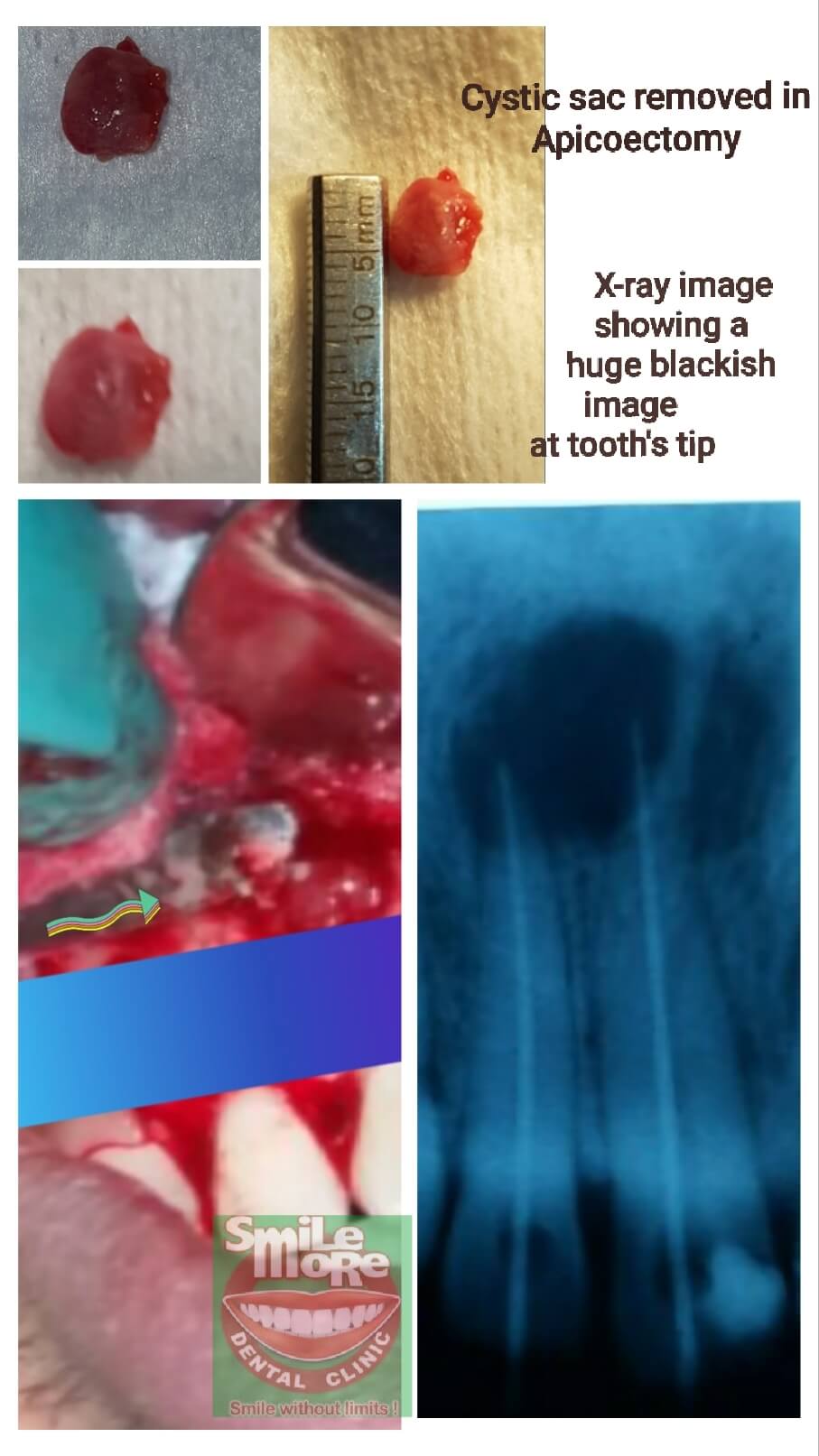
Apicoectomy, or root-end surgery, becomes necessary when a previous root canal treatment fails to resolve an infection or dental issue. A patient needs this when a previously treated tooth continues to have problems after root canal therapy. Let’s clarify what apicoectomy is and when it’s necessary.
Purpose of Apicoectomy: Apicoectomy treats persistent infections, abscesses, or issues related to the tip of the tooth’s root. In root canal therapy, the dentist removes the infected or deteriorated pulp inside the tooth and cleans and seals the root canals. However, in some cases, bacteria may persist in the tiny accessory canals or the tip of the tooth’s root, leading to ongoing infection and discomfort. Apicoectomy aims to remove the infected tissue and seal the root’s end to prevent further infection.
Indications for Apicoectomy: Typically, dentists require apicoectomy in the following situations:
Persistent Infections: When a tooth continues to exhibit signs of infection or disease, such as pain, swelling, gum boil, or drainage, despite a previous root canal treatment.
Hidden Canals: Sometimes, the tooth’s root may have complex canal systems that were not thoroughly cleaned and sealed during the initial root canal treatment. An apicoectomy can address these accessory canals.
Damaged Roots: If the tip of a tooth’s root is fractured or damaged, it may require surgical treatment to save the tooth.
Calcified Canals: In cases where the canals inside the tooth become calcified or blocked, making it impossible to treat through a standard root canal procedure, apicoectomy may be necessary.
The Apicoectomy Procedure: During the apicoectomy procedure, the dentist or endodontist makes a tiny incision in the gum tissue near the affected tooth, exposing the underlying bone and root tip. The dentist gets rid of infected tissue and any damaged root tip, cleans and shapes the root end, and seals it to prevent further infection. They then suture the gum tissue back into place, and over time, it heals naturally.
Aftercare and Recovery: Patients may experience some discomfort and swelling after an apicoectomy, but this typically subsides within a few days. Dentists may prescribe pain medications and antibiotics to manage pain and prevent infection. It’s essential to follow post-operative care instructions carefully, including maintaining good oral hygiene. Most patients can proceed to their regular activities shortly after the procedure.
In summary, dentists perform apicoectomy as a surgical procedure to address persistent infections, hidden canals, damaged roots, or calcified canals that standard root canal therapy cannot effectively treat. It is a valuable option to save a tooth that might need extraction. Patients experiencing ongoing dental issues despite previous root canal treatment should consult their dentist or endodontist to determine if apicoectomy is the right course of action to preserve their oral health.
Root Canal Treatment: Ensuring Your Smile’s Bright Tomorrow
Now that you’ve read this blog, you know much more about caring for your teeth. Getting a root canal in the Philippines can help you feel better without any pain. It’s a great way to keep your smile looking good and your mouth healthy for a long time. It’s all about maintaining your teeth healthy for a brighter future. Don’t wait – pick the right dental clinic for this tooth-saving treatment. You’ll be on your way to a healthier, happier you, with a big, bright smile as the best part.
Preserve Your Tooth with Root Canal Therapy
Ready to protect your tooth with Root Canal Therapy? Contact Smile More Dental Clinic to book your consultation or learn all about our top-notch root canal services in the Philippines. Our skilled dental team is ready to answer your questions and give you the fantastic care you deserve. We will help improve your dental health and keep you smiling with confidence.
*Disclaimer: This article offers general information about root canal treatment in the Philippines. It’s not a replacement for expert dental advice. Please consult a qualified dentist for personalized guidance on your dental health.
Dental Tourism in the Philippines: A Cost-Effective Alternative
When people think of the Philippines, the 7,600 islands come to mind. But there’s another rising trend: dental tourism!
1. Savings: Dental care is way more affordable here.
2. Skill: Dentists here show great expertise in their craft.
3. High Standards: The quality of service is commendable.
4. Fast: Get your treatments wrapped up in shorter durations.
5. Ease: Clinics are dynamic, catering to all needs.
Dental work in the Philippines is becoming the smart choice for many! Tourists looking for dental care in Asia choose this country. The Philippines is becoming a hot spot for quality dental procedures. Sun, sea, and smiles await!
Ready for affordable, high-quality dental care in the Philippines? Contact Smile More Dental Clinic now at: info@smilemore.ph (e-mail) or Landline: +632 86429761 or Cell. No. (also Viber and Whatsapp): +639053350118. Your smile deserves the best!
Cost of Dental Care in the Philippines: Surprisingly Low
Many look to the USA or Europe for top dental care. Still, the high costs often push people toward more affordable dental destinations like the Philippines. The Philippines offers a valuable alternative, particularly for cost-effective dental procedures like dental implants and crowns. High dental bills are common in the West, making the Philippines an attractive destination for dental tourism.
Budget-Friendly: The affordable dental prices here are a welcome surprise. Dental care here doesn’t break the bank. It’s much more affordable.
Big Savings: You might save up to 70% on dental implants, crowns, and veneers. You can save a lot on extensive dental treatments.
More Deals: Root canals and teeth whitening cost less, too. Even basic treatments are a deal.
Easy Chat: Filipinos speak English well, making conversations smooth. English is spoken widely, so there are no language barriers.
One Stop Shop: Get all treatments in one place, no running around. No hopping clinics. Everything is under one roof. No referrals are needed.
It’s clear: the Philippines is a top choice for dental work. For dental needs, the Philippines stands out. And it’s obvious why.
Filipino dentists abroad began here in the Philippines. Local ones continue to learn like them.
Standards and Expertise: World-Class Facilities
Contrary to what you might think, dental clinics in Manila are a pleasant surprise! Even at affordable prices, they provide world-class dental services that don’t compromise quality. It’s all about excellent care that fits your budget.
Like many clinics in the Philippines, Smile More Dental Clinic provides top-level care on par with the world’s leading teeth clinics. Dental clinics in the Philippines deliver a standard of care comparable to that of top international facilities, featuring advanced dental technologies and expert dentists. At Smile More Dental Clinic in Manila, you can get help from the best dental people, from those who fix braces to those who give Hollywood smiles.
Why Choose Dental Tourism in the Philippines?
Below are six facts that can help substantiate that Filipino dentists are world-class:
a) International Accreditations: Manila dental centers get nods from big world dental groups. They fit global marks.
b) Graduates from Top Schools: Our dentists learn from the best schools here; some go abroad to learn even more.
c) Positive Patient Testimonials: Online reviews and testimonials by both local and foreign patients highlight the exceptional care they’ve received in Manila’s dental clinics.
d) High-tech Equipment: These clinics show high-tech tools, with 3D shots and lasers. They’re on par with Western devices.
e) English Proficiency: Clear talk stops mix-ups. Proper communication cuts mistakes. The Philippines ranks third in English, aiding dentist-patient chats.
f) Returning Patients: Many foreign patients come back to the Philippines. Past care quality built their trust.
Addressing Common Questions and Worries About Philippine’s Dental Scene:
On “Low Cost”: Costs are low in the Philippines because of cheaper living. It doesn’t mean poor service.
On Training: Some doubt our training quality. Many Filipino dentists train here and learn from abroad, too.
On Materials: Some might doubt the dental materials because of the cost. However, many clinics get materials from the same suppliers as Western ones.
On Hygiene: People shouldn’t worry about cleanliness. Top Manila clinics follow tight rules like global standards.
On Expertise: Many think top dentists are in the West. Yet, Filipino dentists train there and are known worldwide.
On Results: Don’t just trust word-of-mouth. Before-and-after photos and reviews prove the top results from these clinics.
Range of Dental Treatments: Comprehensive Choices
Dental tourism in the Philippines offers many options. Need implants, crowns, or dentures? You’ll find them all here. The clinics here cater to various dental needs, ensuring everyone finds the right fit.
But it’s not just about the basics. The Philippines is also home to experts in veneers and orthodontics. So whether you want to straighten your teeth or improve their look, you’re in the right place. With such a vast choice, you can get the smile you’ve always dreamed of at Smile More Dental Clinic.
What’s more, these top services don’t drain your bank account. The prices are fair, making quality dental care accessible to many. It’s clear why many choose the Philippines for their dental journeys.
Making it a Dental Vacation: More Than Just Treatment
Your dental trip to the Philippines promises excitement. First stop: a dental clinic in Manila, like Smile More. After that? Discover places like Rizal Park and Fort Santiago. Don’t miss the National Museum to learn about the culture of the Philippines. That’s what makes dental tourism in the Philippines so special. You get top dental care and then dive into fantastic tourist spots. After your dental appointment, explore the city, enjoy delicious food, and relax. It’s a tremendous blend of caring for your health while having fun.
Savings and More: A Wise Decision
The Philippines offers a smart solution for your dental needs. Affordable prices and top dental care meet in this tropical paradise. The cost benefits are clear, especially when compared to Western rates.
But it’s not just about saving money. The Philippines boasts of dental clinics that match global standards. The dentists are experts in their field, ensuring you get only the finest. It’s quality dental care that fits the budget. And as you take care of your dental needs, the Philippines invites you to explore. Dive into its clear waters, sample its unique cuisine, and chat with its warm people. It’s a complete package: great dental care and an unforgettable trip.
Planning Your Dental Trip to the Philippines
Thinking of a dental trip to the Philippines? Planning is simple! Many travelers can stay for 30 days without a visa. But always check visa rules based on where you’re from. When you book a dental date, schedule extra days too. Additional days help with dental checks and allow time for sightseeing. Make sure to prioritize your dental appointments. Proper planning ensures a relaxed trip. So you can enjoy both dental care and vacation without stress.
Accommodations and Easy Travel in the Philippines
In the Philippines, top dental clinics are near big hotels and travel spots. Using Agoda and Expedia, you can find close, good places to stay. Read reviews, find deals, and book easily. Whether staying in Makati, Taguig, Pasay, Paranaque, Mandaluyong, or anywhere in Metro Manila, consider commute time to your chosen clinic. Plan your dental visits and stay early for a smooth trip. Always check clinic locations before booking. This preparation ensures short commutes and more time for fun.
Why Choose the Philippines for Dental Care? Safety!
The Philippines is becoming a renowned dental tourism destination. Why? Our clinics prioritize safety and quality. With strict hygiene protocols like masks, gloves, and sterilized tools and a health-first approach, you’re in good hands. It’s not just about safety; it’s about experiencing top-notch dental care in the Philippines.
Is it reasonable to get dental work done in the Philippines?Yes, the Philippines has good dental clinics, but you must find the best ones. But, just like anywhere, quality can vary. There are many good clinics, but some stand out more. Doing some research can help. Finding the right one is vital to a great smile. The goal is a happy, healthy smile in the right place.
Safe, Ethical Dental Care in the Philippines
Philippines dental tourism isn’t just about great smiles. It’s also about trust and safety. Clinics operate under strict guidelines. If a concern pops up, there are ways to handle it. We’re committed to making sure every patient feels heard and cared for.
Post-Treatment Assurance:
Post-Treatment Assurance:
Local Support: Even after your visit, many clinics offer guidance on post-treatment care.
Clear Instructions: Clinics provide easy-to-follow care steps after your procedure.
Open Communication: Most clinics welcome questions, even if you’re already home.
When selecting a clinic in the Philippines, go for the best. Choosing a top-tier clinic in the Philippines ensures your treatment can last that long.
Dealing with Post-Treatment Issues
Dental tourism in the Philippines has gained a lot of fans. Still, patients might have concerns about post-care. What if there’s an issue once they’re back home? Most top clinics in the Philippines have plans for such events. They offer guarantees for their work, so if problems arise, they have solutions ready.
Guarantee on Work
Getting dental work in the Philippines can save you money. But what about issues after the treatment? Quality clinics there have measures in place. They give guarantees so you can feel safe and cared for.
Premier dental centers in the Philippines stand by their work. They offer assurances, ensuring peace of mind for patients. If a problem comes up, they’re ready to help. It shows they trust their skills and care about patient satisfaction.
Staying in Touch
Always chat with your dental professional in the Philippines after your visit. They want to ensure you’re healing well. If issues arise, they can guide you. Some may even have ties with dentists back in your area.
Best Dental Tourism Trips in Asia: Why Pick the Philippines?
Several countries might come to mind when considering dental tourism in Asia. But the Philippines is gaining a reputation as a top choice. Excellent care, skilled dentists, and budget-friendly prices make it shine.
Let’s talk cost. While places like Thailand and India offer good deals, the Philippines often provides treatments at an even better price. And these savings don’t mean low quality. Filipino dentists use up-to-date tools and follow international standards.
Quality care is a hallmark of the Philippines. Dentists here are not just skilled but also globally trained. Many have degrees from top overseas schools, offering expertise on par with the West.
There’s also the broader Philippine experience. Gorgeous beaches, historic cities, and friendly faces await. While every country has its gems, the Philippines offers a blend of culture and care that’s hard to match.
Time is of the essence in dental tourism. Filipino clinics get this. They offer efficient service, understanding tourists’ needs for quick, thorough treatments.
Post-treatment care in the Philippines stands out. Patients receive top-tier guidance and support, ensuring they leave satisfied.
The ease of speaking English is a big plus in the Philippines. Tourists find comfort in clear communication, something not always guaranteed elsewhere in Asia.
Wrapping up, the Philippines makes a strong case for Asia’s top dental tourism spot. It mixes quality, value, and a memorable travel experience.
Looking for top-notch yet affordable dental care in the Philippines? Reach out to Smile More Dental Clinic today at e-mail: info@smilemore.ph or Landline: +632 86429761 or Cell. No. / Viber: +639053350118. Your smile deserves the best!
Dental Tourism: Making the Most of Your Insurance
Insurance and Your Trip: When thinking of dental tourism, ask about insurance. Does it cover care in the Philippines? Can you use it in the Philippines? Will it work when you get home?
Coverage in the Philippines: Many clinics offer good deals. But some global protection plans might cover your costs. Some worldwide insurance policies may chip in. Always check with your provider before your visit.
Claiming Back Home: After treatment, you may ask, “Can I claim this?” Some assurance plans allow claims for overseas care. Always check the details first.
Essential Advice: It’s wise to contact your clinic and insurance firm directly. Know the costs covered. Be clear on what they’ll pay. It ensures a smooth trip. It helps plan a stress-free visit.
Plan Your Dental Visit: Scheduling Tips
Plan Ahead: With rising demand, Smile More suggests booking 3 to 4 weeks before your visit.
Stay Flexible: While we try our best, exact times can change. We value your time. But slight shifts can occur. We’ll always inform you. But we ensure top care.
Reach Out: Use e-mail, Viber, or our landline. We’ll make sure your slot is secure.
In Conclusion: A Smile Worth the Trip
Imagine visiting a beautiful country where you can receive exceptional dental care and save money. That’s exactly what the Philippines offers: low-cost dental work with high quality.
Although Smile More Dental Clinic does not operate in Makati or Taguig, patients seeking dental tourism in Makati or dental tourism in Taguig will discover that our services are competitively priced and easily reachable from these vibrant centers. Choosing our clinic lets you explore the broader landscapes and attractions of the Philippines, thereby extending the value and enjoyment of your dental tourism journey.
Here at Smile More Dental Clinic, we offer a variety of services. We equip our facilities with the latest technology and staff them with skilled professionals ready to assist. Once your appointment concludes, the adventure begins. Explore numerous places, from bustling city streets to stunning tourist attractions.
Think of it this way: Receive top-notch dental care and then enjoy a vacation. All at a cost often lower than just the dental work back home. It’s a win-win in the Philippines.
Disclaimer: We put together this article for general knowledge. Before choosing dental treatments or services, seek advice from a licensed healthcare expert. The views expressed here are based on current data and may not reflect recent developments or practices.
We often overlook our jaw’s role in daily life. The TMJ connects the lower jaw to the skull, helping us talk and eat.
Think of it as a hinge near your ear, made up of bones, cartilage, muscles, and ligaments.
This hinge works like the ones on doors, allowing your jaw to open and close smoothly.
Imagine waking up every morning with a jaw so tight it feels like it’s locked. This feeling isn’t just discomfort; it’s a sign of Temporomandibular Joint Disorder (TMD), a persistent condition that can disrupt your daily life.
This guide will examine how TMD impacts your daily life and discuss effective treatment options to restore your comfort and well-being.
When TMJ Harmony Goes Wrong: Temporo-Mandibular Joint Disorder (TMD)
Temporomandibular Joint Disorder (TMD) can cause jaw pain and discomfort. Many don’t realize they have it. What causes TMD? Factors include:
Teeth Grinding and Clenching: Bruxism, or nightly grinding, often leads to TMD.
Stress and Anxiety: These can cause jaw tension, leading to TMD.
Trauma or Injury: A facial injury can trigger TMD.
Teeth Alignment Issues: Problems with how teeth fit together can cause jaw issues.
Missing Back Teeth (molars): Not replacing these teeth can lead to TMD.
Recognizing TMD Symptoms – Warning Signs!
Look out for these TMD signs for early treatment:
Clicking and Grinding Sounds: When you open your mouth, these noises may mean TMJ issues.
Lockjaw: If your mouth locks open, TMD might be the cause.
Limited Mouth Opening: Trouble opening your mouth wide? Could be TMD.
Jaw Joint and Muscle Pain: Achy jaw muscles or joints? TMD might be to blame.
Headaches and More: Dizziness, headaches, and earaches can also be due to TMD.
Sleep Disruptions: TMD can affect your sleep, causing discomfort.
Choosing Relief: The Non-Surgical Approach for TMD Management
Early detection can prevent TMD from getting worse. While surgery is an option for some, many patients find relief through non-surgical means. These options typically involve less risk and a shorter recovery period. For example, fixing jaw alignment can help with TMD.
Some popular non-surgical treatments include physical therapy, oral splints, and medication to reduce inflammation and pain.
A Gentle Approach: At Smile More Dental Clinic, we prioritize a non-invasive approach, offering custom tips for TMJ management. We provide non-surgical ways to fix jaw misalignment. Let’s find the best solution together.
Surgical TMD Treatment: When It’s Necessary
In some cases, surgery becomes a necessity, particularly when the jaw joint is severely affected. Surgical intervention aims to restore proper function but is a substantial step with variable outcomes.
Non-Surgical vs. Surgical: Making the Right Choice
The decision between surgical and non-surgical treatment can be challenging. Our Smile More Dental Clinic team will work with you to weigh the pros and cons, and you will know that the chosen treatment aligns with your specific needs and lifestyle. With non-surgical options, we personalize care to your precise requirements. Our method gradually addresses symptoms and root causes, avoiding invasive procedures and prolonged recovery times.
TMJ Treatment Cost – How Much Should You Pay?
Understanding TMJ treatment costs is like starting a personal journey. Each person’s story is different because jaw problems grow slowly. These might come from not fixing missing teeth or having teeth that don’t line up right. When you start feeling jaw pain, it’s essential to take action.
When considering the cost of TMJ treatment, remember it’s not just about spending money. It’s about feeling better and staying healthy for a long time. If you wait too long to get help, your jaw might hurt more and cause bigger problems. Spending money on your jaw problem now is like helping yourself avoid constant headaches and pain. It’s super important to think about how much better you will feel, not just how much it will cost. Feeling good and not having pain is worth it.
An excellent first step is to see a dentist. This move shows you’re serious about getting better and improving your health. You might think about needing tests or a dentist’s opinion. Here’s the deal: that’s a brilliant idea. Finding out the exact issue with your TMJ helps a lot. Dentists must see you to know what’s happening; they can’t guess over the phone. So, a dental check-up is the best way to understand your TMJ problem and get the proper treatment.
Your Path to Lasting Comfort: Non-Surgical TMD Treatment
Curious about non-surgical treatment? Here’s how it works:
Evaluation: We check your oral health and teeth for TMD signs.
Diagnostic Tests: We will request TMJ X-rays and panoramic X-rays and create models and photos of your jaw to understand your condition thoroughly.
Therapeutic Care: Transcutaneous Electrical Nerve Stimulation (TENS) for pain relief, as required. TENS therapy uses mild and easing electrical pulses to help relieve pain and improve TMJ function.
Custom Appliance: A tailor-made TMJ Splint moves your jaw to a better spot, stopping teeth grinding.
Sustainable Comfort: Avoid post-op issues. Enjoy better jaw function and comfort.
Reclaiming Comfort: Ready to take a step towards a pain-free life?
Contact Smile More Dental Clinic for expert help with your TMJ problem. Our dedicated team is here to guide you towards comfort and health. For more information or to schedule an appointment, you can reach us at (+632) 8 6429761 (Landline) or message +63905-3350118 (Cell. No. / Viber)
By visiting our website, you accept our use of cookies. We utilize cookies to serve you with an overall great experience and run and streamline our website efficiently.Ok