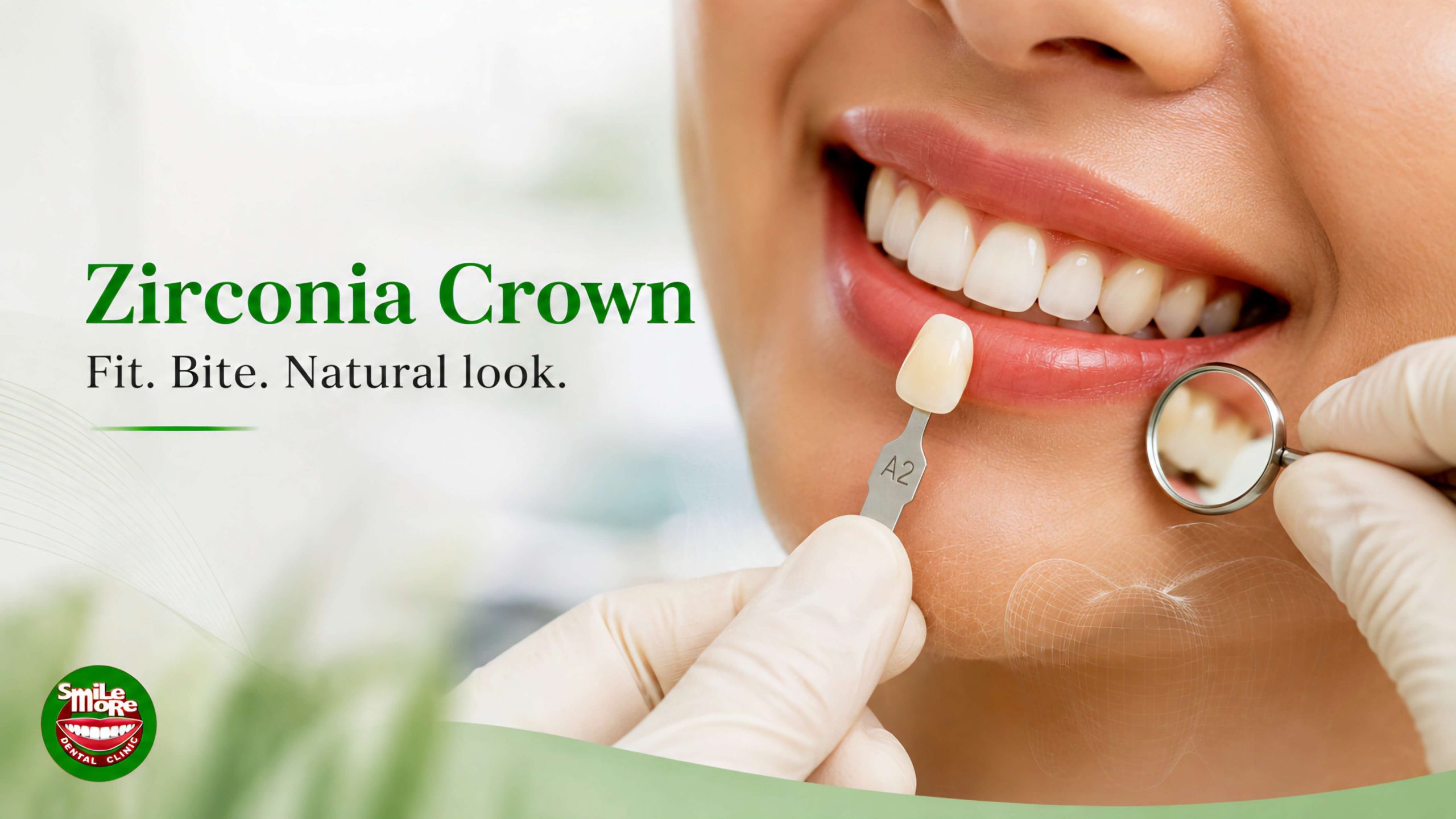
A natural-looking zirconia crown should look like it belongs—and feel like it has always been there.
A crown may look smooth and white on a screen.
Then you bite.
One tooth hits first. Your tongue finds a thick edge.
Or you smile, and one tooth keeps catching your eye because it looks too bright, too long, or too wide.
A back crown must take chewing force without feeling high.
A front zirconia crown has another job: it should sit beside your natural teeth without stealing attention from your smile.
Zirconia gives you a metal-free ceramic crown, but the material alone does not create the result.
The dentist still has to shape the tooth, check the bite, match the shade, and make sure the crown sits comfortably with the teeth around it.
So before you finish treatment, ask:
“Will this natural-looking zirconia crown feel right when I bite—and belong in my smile?” That is what this guide will help you check
Are All Zirconia Crowns the Same?
No.
They may all carry the name zircon or zirconia, but they do not all behave or look the same.
A back molar takes the force of chewing every day. A front tooth sits where light, lips, and nearby teeth make every small difference easier to see.
So the dentist may choose a zirconia ceramic crown with more focus on strength for one tooth and more translucency for another.
You may hear terms such as:
- Monolithic zirconia — mostly one solid zirconia structure.
- Layered zirconia — zirconia with added ceramic work for more shape, shade, or surface detail.
- High-translucency zirconia — a zirconia restoration that lets more light pass through, which may help a visible tooth look less flat or opaque.
A natural-looking zirconia crown should not be the first tooth your eye finds in the mirror. It should sit beside your natural teeth without looking too white, too flat, or too bulky.
So do not let the word premium decide for you.
Ask:
“Why does this type of zirconia suit this tooth?”
The best material is the one that fits the job the tooth has to do—and the way it needs to look while doing it.
What to Check Before Choosing Your Zirconia Crowns
Different zirconia types can also come with different fees. If you are comparing quotes, see what can change the price of a zirconia crown in the Philippines.
But before the scan or lab work begins, the tooth itself needs to be ready. If there is pain, an old root canal, swollen gums, or too little healthy tooth left, see what your dentist should check before a zirconia crown goes on.
Natural Looking Zirconia Crown: It Starts With a Clear Record
Once the tooth is ready, the lab needs a clear copy of it.
The dentist may use a digital scan or a precision impression.
Different tools. Same job.
The record needs to show the prepared tooth clearly—especially the fine edge where the new ceramic crown will meet it.
If the scan misses that edge, the milling machine cannot guess what belongs there.
If the impression pulls out of shape, the lab starts with the wrong copy.
So even good technology needs good information.
Research shows that both digital scans and conventional impressions can produce zirconia crowns with acceptable fit when the dentist captures the prepared tooth well.
Instead of asking only:
“Do you use a digital scanner?”
Ask:
“How will you make sure the lab gets a clear copy of my tooth?”
Give the lab the right tooth to copy before it makes the crown.
Natural-Looking Zirconia Crown: Looks Good, But How Does It Bite?
Some crown problems do not show in a photo.
You feel them.
The new zirconia crown may look smooth and even. Then you close your mouth, and one tooth touches first.
Or your tongue keeps finding a thick edge.
Food may catch beside the crown.
That is why zirconia crown fit means more than how the crown looks.
Before the crown stays, the dentist should check:
- The bite — Does the crown meet the opposite tooth evenly?
- The contact — Does it sit properly beside the nearby teeth?
- The shape — Does it feel too thick, long, or bulky?
- The surface — Does your tongue keep finding a rough or sharp area?
- The comfort — Does chewing feel natural?
Clinical research shows that occlusal design and adjustment matter for zirconia crowns, especially because bite adjustment can affect wear and surface behavior.
So do not judge a ceramic crown only while your mouth is open.
Close your teeth.
Chew.
Notice what your tongue keeps finding.
A computer can design the crown.
A milling machine can shape it.
Neither can tell the dentist how the crown feels in your mouth.
It Looked Great on the Screen. Will It Look Right on Your Face?
A digital smile preview can help you picture a possible result.
But the finished zirconia crown still has to work on your face—not on a tablet.
A front crown may look neat on screen, yet feel too long, too wide, too bright, or simply out of place beside your natural teeth. That is why smile planning should look beyond white, straight teeth. Dental esthetic planning also considers how the teeth relate to the gums, lips, facial midline, and the amount of tooth that shows when you smile.
| What the dentist should check | What you may notice |
|---|---|
| Tooth length and width | A front crown should not look stretched, narrow, or oversized beside nearby teeth. |
| Shade and how light passes through it | The crown should not look too bright, flat, or opaque when light hits your smile. |
| Gum line | The crown should sit naturally with the gums around it. |
| Lip position | The dentist should see how much tooth shows when you talk, laugh, and smile. |
| Face and midline | The new crown should sit in balance with your smile and facial features. |
So if your treatment includes Digital Smile Design, ask:
“How will this preview translate to my real face?”
A preview can guide the plan.
You live with the result in the mirror.
Does an In-House Lab Mean a Better Zirconia Crown?
Not by itself.
An in-house dental lab can shorten the back-and-forth between the dentist and technician. A shade, shape, or small adjustment may be easier to discuss when the work happens nearby.
An outside dental lab can also make an excellent crown.
What matters is what travels between them: a clear record, clear instructions, and a crown that the dentist checks before it stays.
| You may hear | What it may change | What it DOES NOT prove |
|---|---|---|
| In-house lab | Faster communication or easier adjustments in some cases | That the crown will automatically fit or look better |
| Outside dental lab | The case travels to a separate technician or laboratory | That the crown will be less accurate |
| CAD/CAM zirconia | A computer helps design the crown and a machine mills it | That the computer makes every clinical decision |
| Same-day crown | A shorter workflow may be possible in some cases | That faster always means better |
Comparing two clinics? The laboratory is only one part of the workflow. -> See how to compare zirconia crown quotes by looking at the diagnosis, tooth preparation, records, try-in, bite checks, and follow-up.
Why Technology Can’t Replace the Dentist’s Eye
CAD/CAM now plays a major role in making ceramic and zirconia restorations. However, the digital system still depends on the tooth preparation, the record sent to the lab, and the final clinical checks.
So if a clinic proudly says:
“We have our own milling machine.”
A better question is:
“Who checks the crown after the machine makes it?”
Because the machine does not see your whole smile.
It does not feel your bite.
And it does not hear you say:
“This tooth feels a little high.”
The lab makes the crown. The dentist still has to make it work in your mouth.

How Smile More Plans a Natural-Looking Zirconia Crown
At Smile More Dental Clinic in Ermita, Manila, zirconia forms part of our regular crown work.
But we do not start with the zirconia.
We start with the tooth.
Before the lab makes the crown, we check what the tooth needs and what the finished crown has to do.
| What we look at | What we want to know |
|---|---|
| Tooth | Is it healthy and strong enough for a crown? |
| Bite | When you close and chew, does the crown meet the opposite teeth evenly—or does it hit first, feel high, or carry too much of the bite? |
| Nearby teeth | How should the crown sit beside them? |
| Shape and shade | Will a visible crown blend into the smile? |
| Scan or impression | Does the lab have a clear copy of the prepared tooth? |
| Lab instructions | Does the technician have the shade, shape, bite, and case details needed to make the crown? |
A good bite should feel balanced enough that you can chew without constantly noticing the new crown.
Then the dentist and laboratory technician have different jobs.
The technician uses the records and instructions to make the zirconia restoration.
The dentist checks how that crown works in the mouth.
Does it sit comfortably?
When you bite, do the teeth meet evenly?
And when you smile, does the front crown blend in—or catch your eye?
If the tooth needs a build-up, root canal treatment, or other care first, we explain that separately from the zirconia crown fee.
Working with zirconia regularly also keeps our attention on the small things patients notice every day—a tooth that hits first, an edge the tongue keeps finding, or a front crown that draws the eye for the wrong reason.
For patients from Manila, Metro Manila, or visiting the Philippines, the goal stays simple:
Make the crown work with the tooth, bite, and smile already there.
Planning a zirconia crown? We can check the tooth, bite, and treatment plan with you before you decide.
Appointments often fill up in advance, so booking early helps
Frequently Asked Questions (FAQ’s)
1. What makes a natural-looking zirconia crown?
A natural-looking zirconia crown depends on more than shade. Shape, translucency, tooth length, gum line, nearby teeth, and how the crown sits within your smile all matter. The dentist also needs to consider the shade, shape, tooth length, translucency, nearby teeth, gums, and your smile. A front crown should not be the first tooth your eye finds when you look in the mirror.
2. What should a well-fitting zirconia crown feel like?
Ideally, it should become something you stop noticing.
When you close your mouth, one tooth should not hit first. Food should not keep catching beside it, and your tongue should not keep finding a thick or rough edge.
A comfortable crown should let you bite and chew without constantly reminding you that it is there.
3. Why does my zirconia crown feel high when I bite?
The crown may be touching the opposite tooth before the rest of your teeth meet.
Even a small difference can feel obvious when you chew.
Tell your dentist rather than trying to “get used to it.” The dentist can check the bite and decide whether the crown needs adjustment.
4. Is monolithic zirconia better than layered zirconia?
Not for every tooth.
Monolithic zirconia uses mostly one zirconia structure and may suit areas where strength matters.
Layered zirconia adds ceramic work that can help with color, shape, and surface detail.
The better question is:
“Which type suits this tooth and why?”
5. Is a digital scan better than a traditional impression for a zirconia crown?
Not automatically.
Both methods can give the dental laboratory a useful record when the dentist captures the prepared tooth clearly.
What matters is whether the record shows the tooth and crown edge well enough for the lab to work from.
Good technology still needs a good record.
6. Does Digital Smile Design guarantee how my zirconia crown will look?
A digital preview can help you and your dentist discuss shape, length, shade, and the overall smile before treatment.
But the finished crown still needs to work with your real teeth, gums, lips, bite, and face.
The preview guides the plan. You live with the result in the mirror.
7. Does an in-house dental lab mean a better zirconia crown?
Not by itself.
An in-house lab may make some communication or adjustments easier.
An outside dental laboratory can also produce excellent work.
What matters more is the chain:
clear tooth record → clear lab instructions → careful crown work → final fit and bite check.
Disclaimer:This guide is for general information and does not replace a dental consultation. Your tooth, bite, and smile are unique, so a licensed dentist should assess your case before treatment.